

Eastern cottonwood
- noun
- /ˈiːstərn ˈkɒtənwʊd/
- US
- Eastern cottonwood is common on sandy sites, whereas green ash grows best on finer, more fertile soils.
- Eastern cottonwood and elder
- box elder and eastern cottonwood
- Eastern cottonwood and maple
Examples
-
Additional riparian species common in the Coastal Plain and found along stream valleys to the west include green ash and eastern cottonwood.
Academic text (2012) -
Eastern cottonwood II: Low well-drained soils, widely distributed on lower bottomlands.
Academic text (2012) -
The eastern cottonwood is known for its rapid growth and tall stature, making it a popular choice for landscaping in suitable climates.
-
In the park, we spotted several fully-grown eastern cottonwood trees shimmering in the sunlight with their abundant green leaves.
-
Farmers often plant eastern cottonwood near water sources because of its ability to thrive in wet soils.
Synonyms

 15
5.1
15
5.1

A large North American tree with soft wood and seeds with cottony hairs
 9
4.4
9
4.4
A tall tree with light wood and small hanging flowers that grows in cool areas
 2
3.0
2
3.0
A tall tree that grows quickly with light wood and long hanging catkins
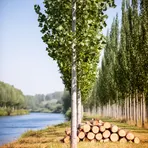
A fast-growing poplar tree with broad leaves often planted near rivers for timber

A fast-growing tree with large leaves grown for wood and shade

A group of trees like poplars and aspens that lose their leaves in winter
Surface Forms
Morphology
This is a straightforward adjectival + noun combination: 'eastern' (from the east) modifies 'cottonwood' (a type of tree), so the phrase transparently denotes a cottonwood found in the eastern region. There is no idiomatic or metaphorical meaning, and this compositional pattern is cross-linguistically common, so a B1 learner who knows both words will understand it.
Etymology
Eastern cottonwood may get its name from the tree's white, cotton-like seeds that float through the air like snow. The word cottonwood links cotton, the fluffy seeds, with wood, the tree itself, and 'eastern' shows where it grows, so the name means a tree with cotton-like seeds found in the east.