
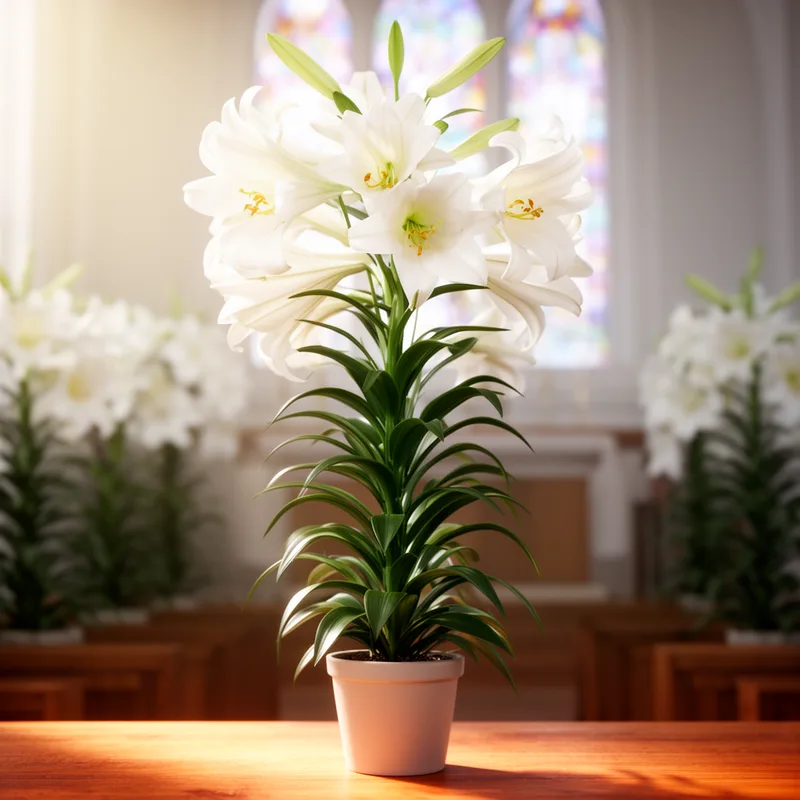
Easter lily
- noun
- /ˈiːstər ˈlɪli/
- When you visit a garden center in March, you can often find Easter lilies ready for planting.
- Easter lily flower
Examples
-
He brought all the Easter lilies that were left over from last month.
Fiction book (1991) -
His arm was thrown companionably around my shoulder; my arms were wrapped around an enormous bunch of Easter lilies he had given me.
Fiction book (1997) -
Maybe you could be allergic to an Easter lily?
Fiction book (1991) -
She was bowed over her work, filling in with her needle and a length of yellow thread the bright corolla of a jonquil—or "Easter lily," as she would have called it.
Fiction book (1992) -
Every spring, I decorate my home with beautiful Easter lilies that bloom around the holiday.
-
The florist had a stunning display of Easter lilies for the church's flower arrangements this weekend.
Synonyms
A tall white lily with large trumpet-shaped flowers that bloom in spring

A tall plant with large white trumpet-shaped flowers that bloom in spring
Surface Forms
Morphology
The meaning is directly compositional: a 'lily' associated with 'Easter' (a flower used or blooming around the Easter holiday), so a learner who knows both words can infer this refers to a type of lily linked to the holiday. This noun–noun combination follows a common, cross-linguistic pattern of naming plants by their cultural or seasonal associations, making it immediately understandable to B1 learners.
Etymology
Easter lily may come from the old habit of putting large white lily flowers in churches at Easter. Because people saw these lilies as signs of 'purity' and 'new life', the name came to mean the white flower linked to Easter celebrations.

