
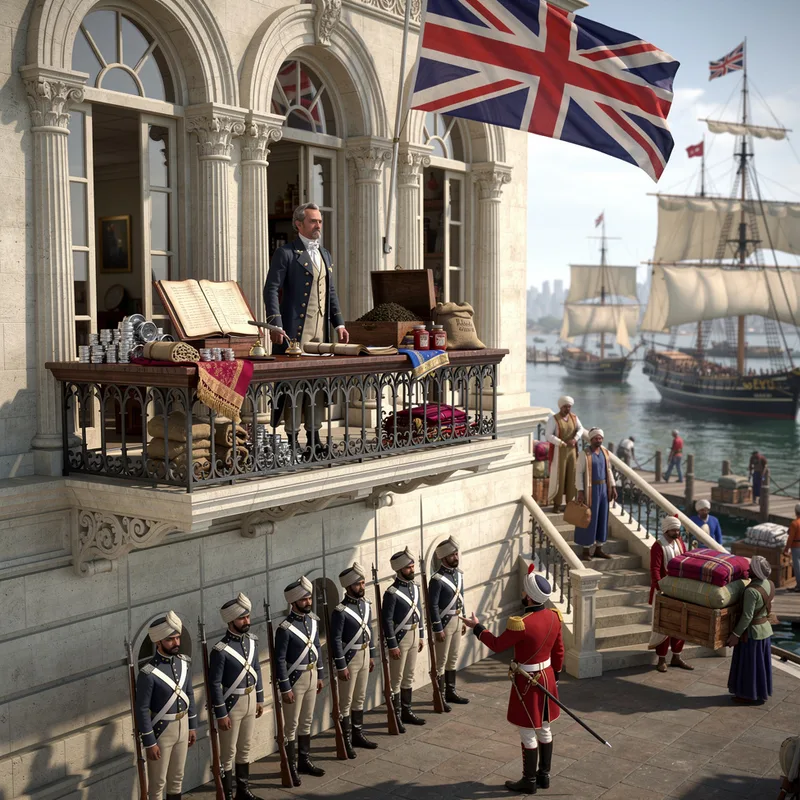
East India Company
 2
5.8
2
5.8

- proper noun
- The East India Company played a significant role in establishing British trade routes in Asia.
- the British East India Company
- the Dutch East India Company
Loading YouTube…
Watch on YouTubeThink of what happened when England went into India after England conquered the British East India Company, I should say, conquered England.
- Think of what happened when England went into India after England conquered the British East India Company, I should say, conquered England.
Examples
-
The East India Company was granted a royal charter by Queen Elizabeth I in 1600.
-
India, or rather some Indian kings, allowed the East India Company to set up trading in India.
Blog text (19) -
You vanished from under the eyes of seven agents of the East India Company.
-
All this contributed to a surplus of unsold tea, putting the East India Company in financial difficulties.
Blog text (11) -
When James Brookes, then a young English officer with the East India Company, arrived in Borneo in 1839, the Sultan sought his help to put down the rebellion.
Academic text (2007) -
In order to try to reverse their silver outflow, the British, through the East India Company, devised a plan to grow opium in their Indian colonies and export it to China.
Academic text (2008) -
Upon graduation, Jardine was hired as an employee of the East India Company, enlisting as a surgeon's mate aboard the RCS Brunswick.
-
History begins in 1822 when Raffles signed a treaty with Sultan Hussein Shah of Johor, giving the British East India Company the rights to set up a trading post.
Academic text (2016) -
Many historical documents detail the influence of the East India Company on Indian politics and economy.
Synonyms
An old informal name for the British trading company that ruled parts of India
Surface Forms
Morphology
The phrase is compositionally built from 'East' + 'India' + 'company' so a learner who knows those words will infer it denotes a company associated with (or trading in) East India/India. This is a transparent, cross-linguistically common naming pattern, although the specific historical details (British charter, monopoly and political role) are not recoverable from the name alone.
Etymology
East India Company comes from a business set up to do 'trade' in the East, especially in India and nearby lands. At first it bought and sold goods like tea and spices, but over time it hired soldiers and ran towns, so the name now reminds people of both trade and British rule in parts of India.