
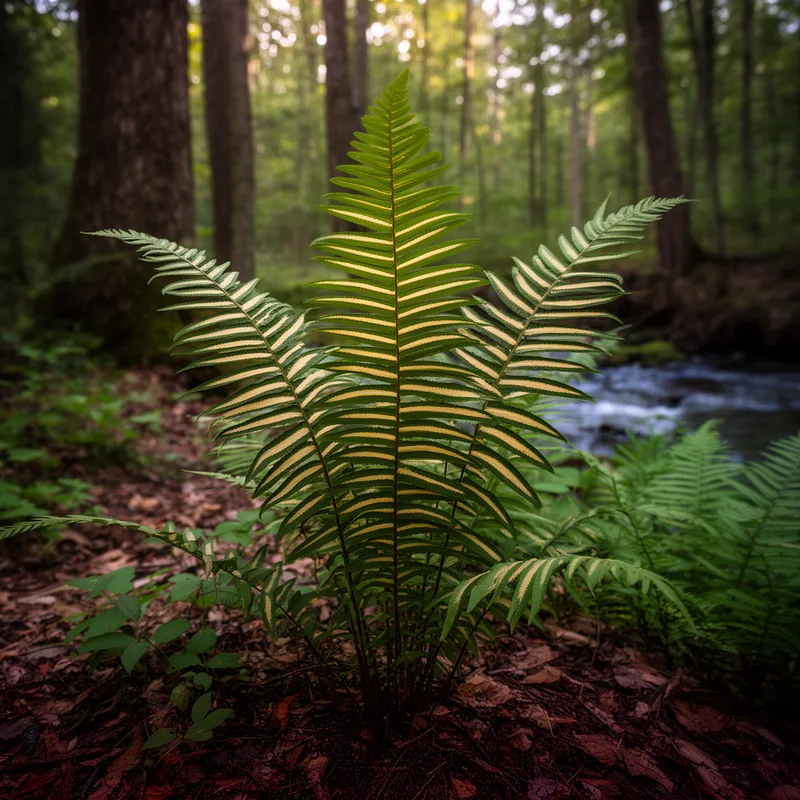
Dryopteris hexagonoptera
- noun
- Specialized
- The straw-colored stripes of Dryopteris hexagonoptera make it easy to distinguish from similar ferns.
Examples
-
Hikers often overlook Dryopteris hexagonoptera despite its abundance in North American woodlands.
-
The Dryopteris hexagonoptera thrives in shaded areas.
-
Botanists discovered a thriving patch of Dryopteris hexagonoptera near the forest stream.
-
Have you seen the Dryopteris hexagonoptera in the woods?
-
The straw-colored stripes of Dryopteris hexagonoptera help to identify this unique species of fern in the woodland.
-
Hikers often overlook Dryopteris hexagonoptera even though it is commonly found in shaded areas of North American forests.
-
Botanists noted that Dryopteris hexagonoptera flourishes in moist, shaded environments within woodland ecosystems.
Synonyms

A fern that grows in North American woods and has light brown stripes

A plant with wide leaves found in North American woods marked by light straw-colored stripes

A fern that grows in eastern North American woods with pale yellow stripes
A fern that grows in shady North American woods with pale yellow stems and leaves
Surface Forms
Morphology
Dryopteris + hexagonoptera
This is a Latin binomial (genus + species epithet) functioning as a taxonomic label rather than a compositional English phrase; knowing 'Dryopteris' only tells a learner it is a genus name and the epithet 'hexagonoptera' is undocumented and uses technical Greek roots unlikely to be known by a B1 learner. Scientific names behave like proper nouns and are essentially arbitrary labels, so the specific meaning ('a species of beech fern with straw-colored stripes') cannot be derived from the constituents.
Etymology
Dryopteris hexagonoptera may come from old Greek words: Dryopteris meaning 'oak fern' and hexagonoptera meaning 'six-sided wing'. The name gives a picture of a fern with a six-sided, straw-colored stripe pattern on its leaves, so it fits the beech fern found in North American forests.

