
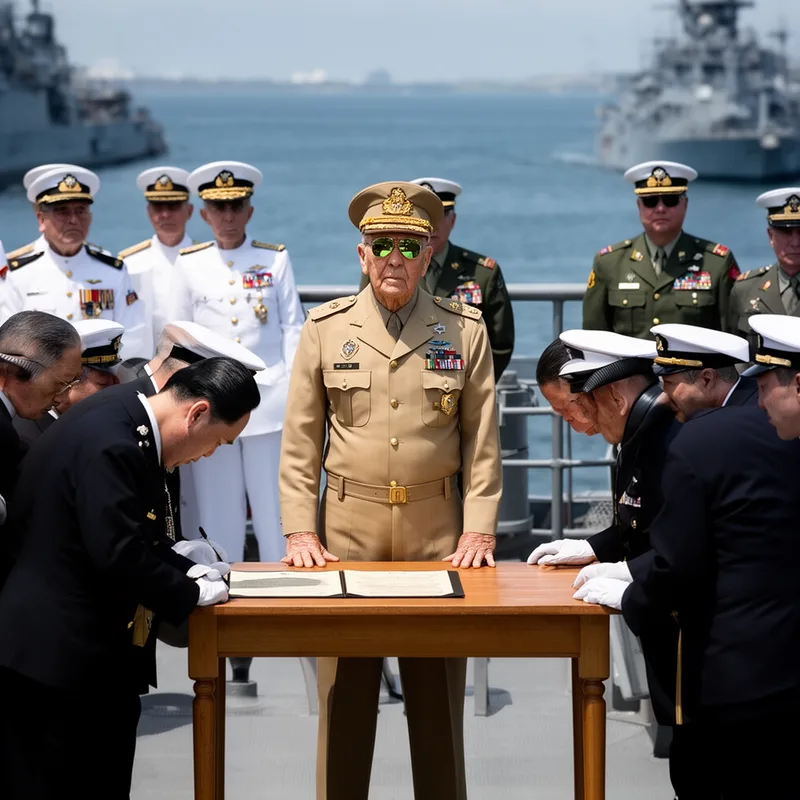
Douglas MacArthur
 7
5.1

- proper noun
- /ˈdʌɡləs mækˈɑrθər/
- Military attaché in Egypt from 1940 to 1942, Fellers moved to the Office of Strategic Services and then worked for Douglas MacArthur.
- General Douglas MacArthur
Examples
-
General Douglas MacArthur and the U.S. occupation forces were able to completely suppress the images and detailed reports of the bombings because the carnage happened so swiftly.
Academic text (2010) -
As well as defending Hirohito, Fellers had a profound commitment to the public mystique of General Douglas MacArthur, whom he promoted as a talismanic genius:
Academic text (2010) -
The obvious analogy was to the post-1945 occupation of Japan under General Douglas MacArthur.
Academic text (2013) -
Instead, he chose to follow Gen. Douglas MacArthur's advice to destroy North Korea's communist regime by crossing the 38th parallel.
Academic text (2010) -
The commander of the UN forces was Gen. Douglas MacArthur, whose plan involved the use of as many as thirty atomic bombs in Korea and China (O'Ballance 377).
Academic text (2013) -
His model was not Afghanistan—which was the implicit precedent for the IIA—but rather General Douglas MacArthur's total and lengthy control of Japanese politics after the Second World War.
Academic text (2013) -
This commitment to and advocacy for athletics was summarized by General Douglas MacArthur (2006) when he stated, "Upon the fields of friendly strife are sown the seeds; upon other fields, on other days, will bear the fruits of victory."
Academic text (2010) -
It focuses mainly on the Psychological Warfare Branch (PWB), approved and begun by General Douglas MacArthur between June and September 1944, which was coordinated out of the South West Pacific Area (SWPA).
Academic text (2010) -
General Douglas MacArthur was a key figure in the Allied operations in the Pacific during World War II.
-
After the war, Douglas MacArthur oversaw the reconstruction of Japan as its supreme commander.
Surface Forms
Morphology
Douglas + MacArthur
This item is a proper name composed of two personal-name elements; knowing the constituents only signals a person’s name, not the specific historical role. The specific meaning (that he was a United States general and WWII commander) cannot be derived from 'Douglas' + 'MacArthur', so the expression is not compositionally transparent.
Etymology
Douglas MacArthur was a very famous American general in World War II who led Allied forces in the Pacific and later accepted Japan's surrender. He famously said 'I shall return' about the Philippines, and that's why people remember him as a bold, powerful military leader.