
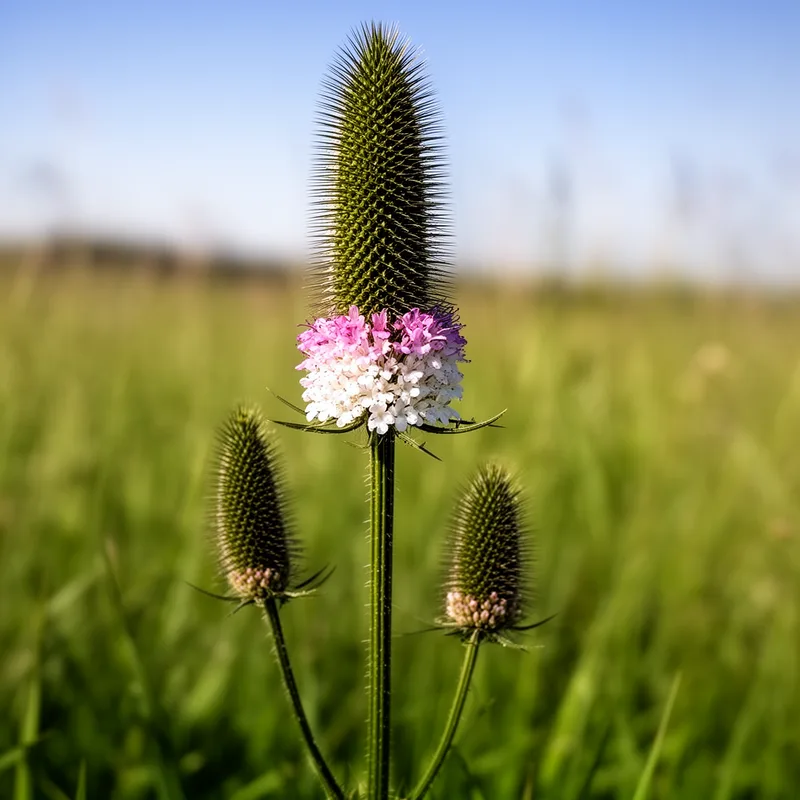
Dipsacus sylvestris
- noun
- Specialized
- Dipsacus sylvestris is often found in meadows and along roadsides across Europe and North America.
Examples
-
Gardeners sometimes plant Dipsacus sylvestris for its decorative seed heads.
-
Have you ever seen Dipsacus sylvestris in bloom?
-
Researchers are studying Dipsacus sylvestris for its potential use in traditional herbal remedies.
-
Dipsacus sylvestris is commonly found in meadows and along roadsides.
-
Dipsacus sylvestris is often found in meadows and along roadsides across Europe and North America.
-
Gardeners sometimes plant Dipsacus sylvestris for its decorative seed heads.
-
Researchers are studying Dipsacus sylvestris for its potential use in traditional herbal remedies.
Synonyms


 1
9.9
A tall prickly plant with spiny flower heads used to brush wool
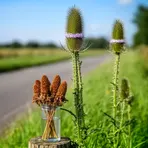
A tall prickly plant with cone-shaped flower heads often dried for decoration
Surface Forms
Morphology
Dipsacus + sylvestris
The binomial is compositionally transparent in form: Dipsacus denotes the teasel genus and the epithet sylvestris (Latin) conveys ‘of the woods’ or ‘wild’, so a speaker who knew both constituents could infer ‘wild/woodland teasel’. However, sylvestris is a Latin taxonomic word not found in the provided dictionary and is not familiar to an average B1 learner, so the meaning is only partially recoverable without prior exposure.
Etymology
Dipsacus sylvestris gets its name from old Greek and Latin: Dipsacus comes from a Greek word for 'thirst' because the leaf bases make little cups that often hold rain, and sylvestris is Latin for 'of the woods' or 'wild'. So the name paints a simple picture of a 'thirsty' wild teasel, which helps you remember this wild species of teasel.