
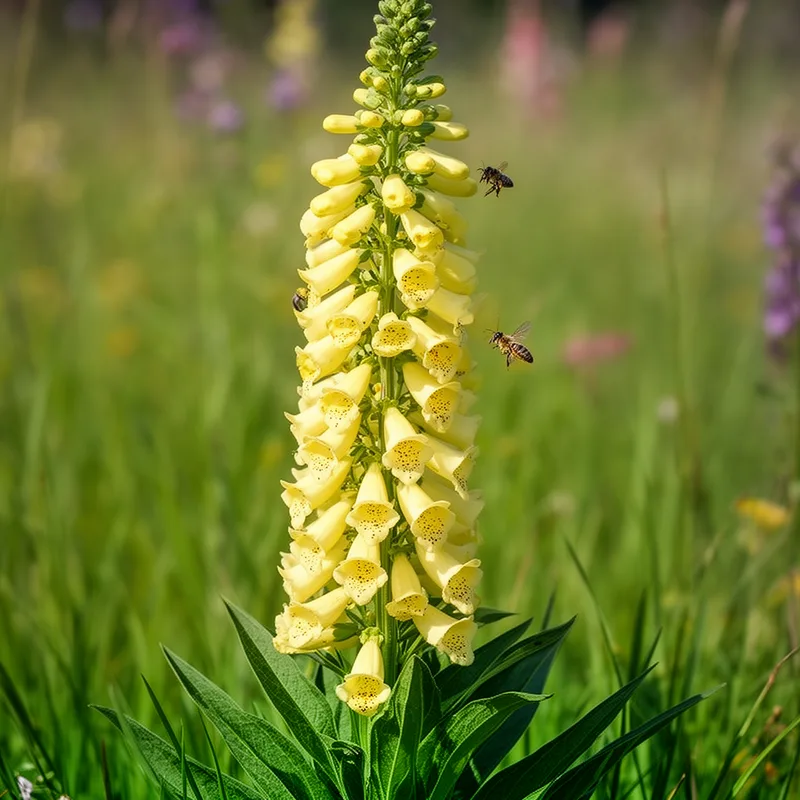
Digitalis lutea
- noun
- Specialized
- Digitalis lutea is known for its striking yellow flowers that bloom in the wild during summer.
Examples
-
Digitalis lutea blooms attract bees and butterflies throughout the summer months.
-
The garden features a rare specimen of Digitalis lutea among many other wildflowers.
-
Many herbalists study Digitalis lutea for its medicinal properties and distinctive appearance.
-
The Digitalis lutea blooms beautifully in the spring.
-
Have you seen the Digitalis lutea in the garden?
-
In our botanical garden, we have a lovely patch of Digitalis lutea among the native plants.
-
The tall stalks of Digitalis lutea sway gently in the breeze, attracting various pollinators.
Synonyms

 6
8.2
6
8.2

A tall plant with bell-shaped purple flowers that are poisonous


 1
8.6
1
8.6
A tall plant with bell-shaped flowers on long spikes like a foxglove
Surface Forms
Morphology
Digitalis + lutea
This is a standard botanical binomial: the genus 'Digitalis' (foxglove) combined with the epithet 'lutea' (Latin for 'yellow'), so a learner who knows both constituents can infer 'yellow Digitalis' — a yellow foxglove. Scientific names are compositional across languages, so the species meaning is directly derivable from the parts.
Etymology
Digitalis lutea comes from Latin: Digitalis comes from 'digitus' meaning 'finger' because the tube-shaped flowers look like small fingers or gloves, and lutea means 'yellow'. So the name simply describes the plant we know today: a yellow wildflower with tube-shaped blooms.