
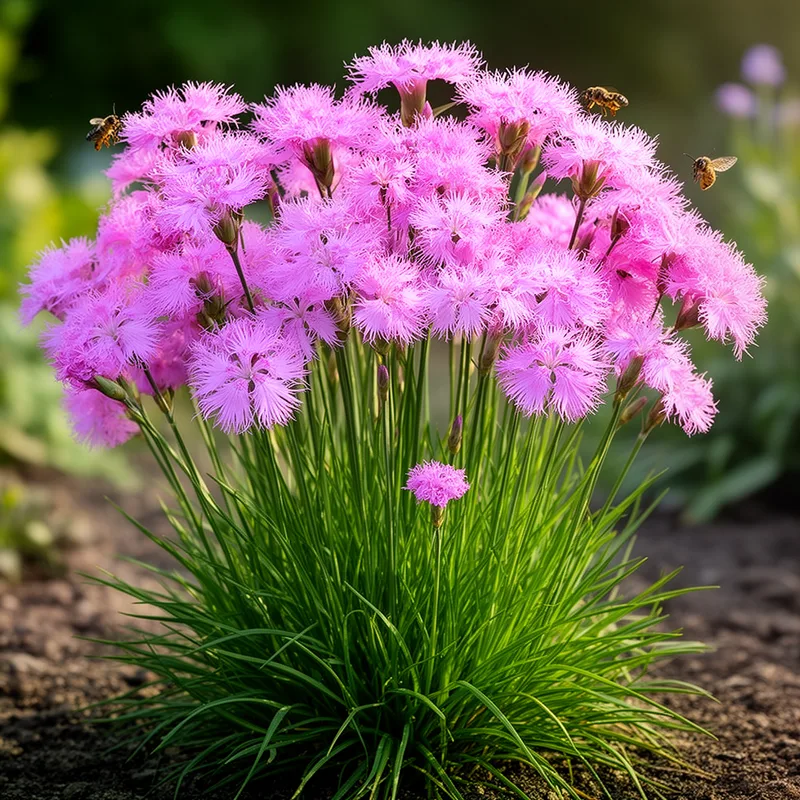
Dianthus superbus
- noun
- Specialized
- The fragrant blooms of Dianthus superbus attract many pollinators to the garden each summer.
Examples
-
Botanists admire Dianthus superbus for its deeply fringed rose-colored petals.
-
The Dianthus superbus blooms beautifully in the spring.
-
Several varieties of Dianthus superbus are popular in ornamental horticulture.
-
Have you seen the Dianthus superbus in the garden?
-
Gardeners often choose Dianthus superbus for its fragrant lilac flowers and distinctive fringed petals.
-
The striking appearance of Dianthus superbus adds color and charm to flower beds in many gardens.
-
During the summer, Dianthus superbus showcases its beautiful blooms, attracting butterflies and bees.
Synonyms

A small plant with pink or lilac flowers that have a lacy edge and a light scent
Surface Forms
Morphology
Dianthus + superbus
This is a Latin binomial: knowing 'Dianthus' (a genus of flowering plants) lets a learner infer it refers to a plant, and if they also knew the Latin-derived adjective 'superbus' ('splendid'/'showy') they could infer 'a splendid Dianthus'. However, the specific species information (fringed petals, fragrance, perennial Eurasian distribution) is not derivable from the parts, and most B1 learners will not know or recognize Latin epithets, so the meaning is only partially predictable.
Etymology
Dianthus superbus comes from old Greek and Latin words: Dianthus means 'divine flower' and superbus means 'proud' or 'showy'. So the name makes a simple picture of a 'divine' and 'proud' flower, which helps you remember its fragrant, rose-colored, deeply fringed petals.

