

Delphic oracle
- noun
- /ˈdɛl.fɪk ˈɔr.ɪ.kəl/
- Literature
- Thus in DK B 101, Heraclitus pays his respects to the Delphic oracle by declaring, "I sought myself."
Loading YouTube…
Watch on YouTubeAnd it it's in Johannes Tobias, if I remember rightly, in the list of maxims that come from the Delphic Oracle.
- And it it's in Johannes Tobias, if I remember rightly, in the list of maxims that come from the Delphic Oracle.
Examples
-
When the Spartans have to consult the Delphic Oracle, men called the pitheoi are the ones who are sent to make the inquiry and bring back the answer.
-
Like an acolyte at the mouth of the Delphic oracle, I was prepared for once to sit back and listen.
Fiction book (1990) -
In the opening scene of the play, the king of Crete asks the Delphic oracle to prognosticate regarding peace in his kingdom.
Academic text (1993) -
It was partly because of these answers that the Delphic Oracle came to be the most famous and well respected Oracle in the ancient Greek world.
-
The king consulted the Delphic oracle for guidance on his troubling dreams.
-
Many ancient Greeks traveled long distances to seek answers from the Delphic oracle.
-
In literature, the Delphic oracle often symbolizes ambiguity and mystique in decision-making.
Synonyms

 8
9.1
8
9.1

A message from a god that tells what will happen
 1
9.9
1
9.9
A priestess at Delphi who speaks messages from the god Apollo


 1
9.9
1
9.9
A priestess of Apollo at Delphi who gives messages about the future

A shrine in ancient Greece where a priestess gave mysterious messages from the god Apollo

A place in ancient Greece where a woman spoke for Apollo and gave unclear predictions
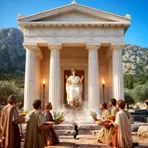
A Greek temple at Delphi where a priestess gives predictions from the god Apollo
Surface Forms
Morphology
The phrase is a straightforward adjective + noun composition: 'Delphic' (ambiguous/prophetic) modifies 'oracle' (a person who predicts or gives advice), so a learner who knows both constituent meanings can infer it refers to an oracle that gives cryptic or prophetic messages. The historical specificity (Delphi) adds cultural nuance but does not prevent the overall meaning being transparently derived from the parts.
Etymology
Delphic oracle comes from ancient Greece, where a priestess at Delphi spoke for the god Apollo and gave short, mysterious answers that needed explanation. Because those answers were often like riddles, people now use Delphic oracle for any statement that is 'mysterious' or 'hard to understand'.