
Declaration of Independence
 53
3.0
53
3.0

- noun
- /ˌdɛkləˈreɪʃən əv ɪnˈdɪpəˌdɛns/
- Formal
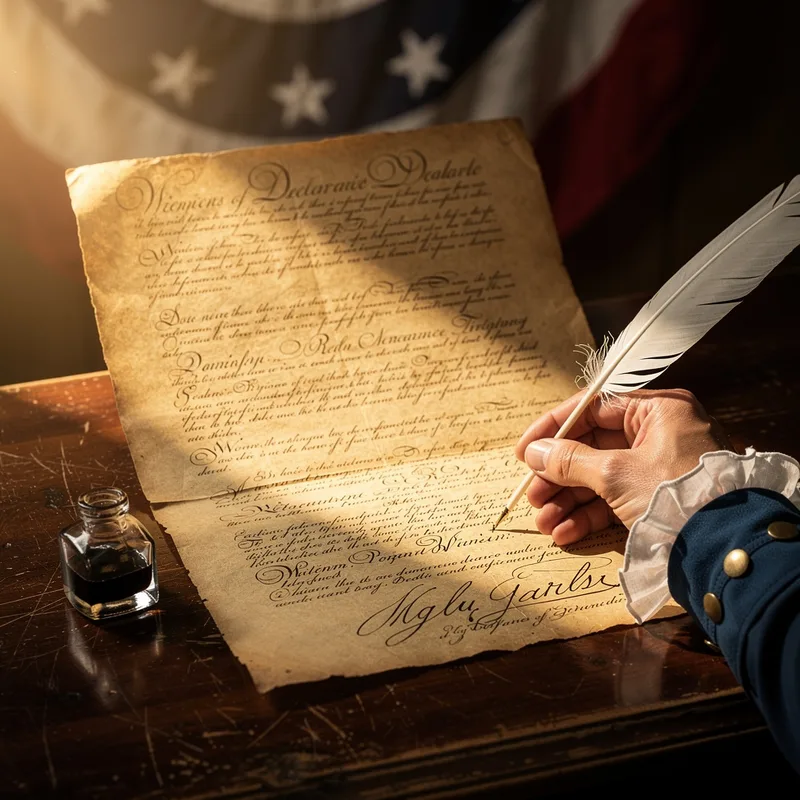
- On July 4, 1776, the Second Continental Congress adopted the Declaration of Independence to proclaim the colonies' freedom from British rule.
- the principles of the Declaration of Independence
- the Declaration of Independence states
- the author of the Declaration of Independence
Loading YouTube…
Watch on YouTubeBut OK, let's start with the Declaration of Independence.
- But OK, let's start with the Declaration of Independence.
- What year was the the Declaration of Independence signed?
- Why use that painting that shows the signing of the Declaration of Independence to start to tease out that idea?
- One of my favorite examples of a just cause is the Declaration of Independence.
- The creed is about the all the values that we like to talk about related to the Declaration of Independence, the Constitution and so on.
- You know, there was this thing called a Declaration of Independence, and they talked about life, liberty and the pursuit of happiness.
- We have an inalienable right like the Declaration of Independence, the the natural law.
- They're, they're tearing down statues of, of people that crafted the Declaration of Independence.
- How big of a fucking little Dick fuck you have to be to write your name that big on the Declaration of Independence?
- But I think the great curse, I think the great curse of the West is in fact the beginning of the Declaration of Independence.
- And many of those ideas were then reflected from the the Masons in the Templar tradition in the Declaration of Independence.
- On the contrary, it's it's Americans with the Declaration of Independence, with this independence that free the slaves in the northern states.
Examples
-
Students should be able to see several of Locke's and Rousseau's ideas in the Declaration of Independence.
Academic text (1996) -
"The Declaration of Independence tells us that we are created equal."
-
And he used the Declaration of Independence as an example.
-
We want a country which shall not brand the Declaration of Independence a lie.
-
In which century was the Declaration of Independence signed?
-
It's where they keep the Declaration of Independence.
-
Our answer is the Declaration of Independence.
-
And we were talking about the Declaration of Independence.
-
Those men are getting ready... to sign the Declaration of Independence, and declare our country... free from England.
-
American political principles, as articulated in the Declaration of Independence, are essentially drawn from the thought of John Locke.
Academic text (2000)
Synonyms

A formal document agreed on 4 July 1776 that declares the thirteen American colonies independent from Britain
Surface Forms
Morphology
declaration + of + independence
The phrase is a straightforward composition of 'declaration' (a formal statement) + 'of' (linking) + 'independence' (state of freedom), so a B1 learner who knows these words can infer it denotes a formal statement proclaiming independence. This noun phrase follows a common, cross-linguistic syntactic pattern, making its meaning transparently derivable from its constituents.
Etymology
Declaration of Independence is the famous written paper that leaders signed on July 4, 1776, to say the American colonies were free from Britain. The word Declaration shows it was a public 'announcement' and Independence means 'freedom', so the name now means that official statement announcing 'independence'.