

Datura suaveolens
- noun
- Specialized
- Many horticulturists prize Datura suaveolens for its stunning, trumpet-shaped flowers.
Examples
-
The garden was filled with the intoxicating scent of Datura suaveolens in the evening.
-
Datura suaveolens blooms at night, attracting nocturnal pollinators with its fragrance.
-
The Datura suaveolens blooms beautifully at night.
-
Many gardeners appreciate the Datura suaveolens for its fragrance.
-
Datura suaveolens produces large, trumpet-shaped flowers that release a sweet fragrance at night.
-
In the evening, the beautiful Datura suaveolens attracts moths with its intoxicating scent.
-
Gardeners often choose Datura suaveolens for its striking blooms and fragrant flowers that open at dusk.
Synonyms
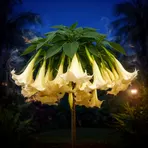
A South American plant with very large trumpet-shaped flowers that have a strong sweet smell at night

A South American plant grown for gardens with large, fragrant trumpet-shaped flowers that are very poisonous if eaten
Surface Forms
Morphology
Datura + suaveolens
This binomial is compositionally transparent: it pairs the genus 'Datura' (a plant genus) with the epithet 'suaveolens' (Latin for 'sweet-smelling' or 'fragrant'), so a learner who knows both constituents can infer it denotes a fragrant Datura. Taxonomic Latin epithets are descriptively compositional and follow predictable patterns, making the meaning derivable rather than idiomatic.
Etymology
Datura suaveolens comes from its large, trumpet-shaped flowers that open at night and give a strong, sweet smell. The Latin word suaveolens means 'sweet-smelling', so the name reminds us it is a night-blooming plant with fragrant, trumpet-like flowers.

