
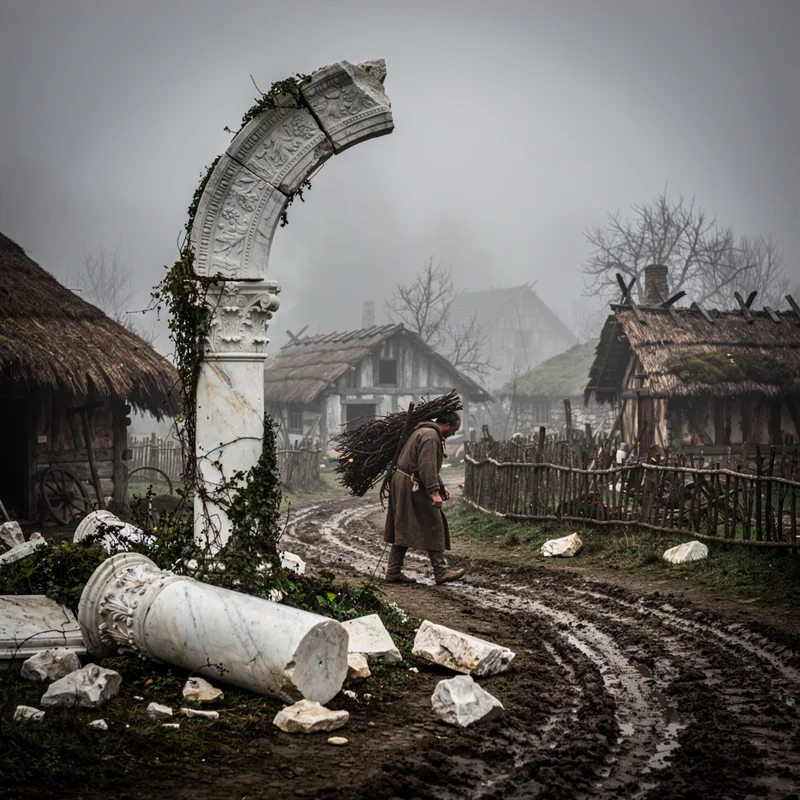
Dark Ages
 21
7.5
21
7.5

- noun
- /dɑrk ˈeɪdʒɪz/
- You're looking at an engraving, an old sketch from the Dark Ages, and fragments of a deteriorated fresco.
- the so-called Dark Ages
Loading YouTube…
Watch on YouTubeAnd so light shone upon the dark ages of Europe.
- And so light shone upon the dark ages of Europe.
- Algebra pulled Europe out of the Dark ages.
- And here we have Spain just being cast back into the dark ages by the church and by the churches need for control.
- And then after Roman comedy, there's no comedy because that's the dark Ages and there's no theater and there's no literacy and there's no playwrights.
- And she says this is what we can associate with the Dark Ages and the Middle Ages.
- You had a longer growing season, raised during the Dark Ages, cold period.
- And then for a long time people called it a dark age.
- You, you see the sort of revival of, of this, you know, oh, it was all dark ages.
- So this opening up from the Dark age to this new age of light is accompanied with many, many challenges when you'd make these transitions.
Examples
-
If it weren't for the army, we'd still be in the Dark Ages; we'd be living in complete chaos.
Fiction book (1996) -
And do you think the Dark Ages are making a comeback, David?
-
This is like the Dark Ages all over again.
-
We're back here in the Dark Ages.
-
It's like something out of the Dark Ages.
-
We don't know how much was lost in the Dark Ages in Europe, but we know what was saved.
Fiction book (1990) -
It was built by a duke in the Dark Ages.
-
The time has come to beat back the repressive forces that prefer the Dark Ages to the Renaissance.
Blog text (5) -
Max, you're still livin' in the Dark Ages.
-
The collapse of the Roman Empire led to the beginning of the Dark Ages, a time marked by cultural stagnation and economic decline.
Synonyms
 45
4.1
45
4.1
A period in Europe from about the 5th century to the late 15th century
Antonyms
 34
6.3
34
6.3
A European movement in the late 1600s and 1700s that values reason and questions old beliefs
 18
5.8
18
5.8
A period in Europe from the 14th to 17th century with new art, science, and learning
Surface Forms
Morphology
The meaning 'a period of cultural/economic decline' is directly inferable from combining 'dark' (metaphorically indicating ignorance, gloom, or decline) with 'age' (a period of time). While the capitalized term refers to a specific historical era after Rome, an average B1 learner who knows the constituents will grasp the general idea of a 'morally or culturally gloomy period'.
Etymology
Dark Ages comes from later writers who called the years after Rome fell 'dark' because there seemed to be fewer books, schools, and written records. That's why Dark Ages today means 'a time of cultural and economic decline'.