
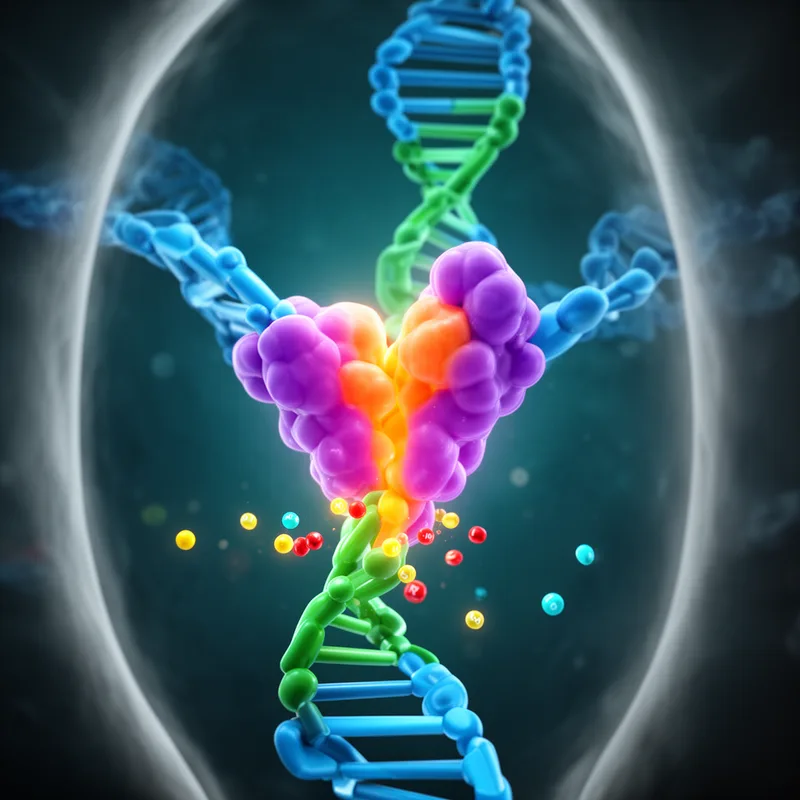
DNA polymerase


 1
3.9
1
3.9
- noun
- /ˌdiːɛnˈeɪ ˈpɒlɪməreɪz/
- Specialized
- But suppose you found a mutant which couldn't make Kornberg's DNA polymerase, but still grew and replicated its DNA.
- Taq DNA polymerase
Loading YouTube…
Watch on YouTubeAnd So what will happen if you give DNA polymerase a template and some dideoxynucleotides?
- And So what will happen if you give DNA polymerase a template and some dideoxynucleotides?
Examples
-
And then in this situation, DNA polymerase would be happy to fill in the rest of the sequence.
-
These same DNA polymerases that replicate the entire genome in the stem cells require magnesium to do just that.
-
Synthesis: The DNA polymerase synthesizes a new complementary strand.
Blog text (18) -
She then added the enzyme DNA polymerase, triggering the polymerase chain reaction, which would cause the section she was interested in to be amplified, reproducing itself over and over again, doubling the quantity each time.
Fiction book (2002) -
The enzyme DNA polymerase synthesizes new strands of DNA by using an existing strand as a template during replication.
-
In the process of DNA replication, DNA polymerase adds new nucleotides to form a complementary strand.
-
During DNA copying, the enzyme DNA polymerase ensures that the sequence matches the original template.
Surface Forms
Morphology
The meaning 'an enzyme that synthesizes DNA' is directly compositional from 'DNA' (the heredity molecule) + 'polymerase' (an enzyme that makes polymers/nucleic acids). This noun–noun scientific naming pattern is regular and cross-linguistically transparent, so a B1 learner who knows both constituents would be able to infer the MWE's meaning.
Etymology
DNA polymerase comes from DNA plus the word polymerase, and polymerase joins polymer meaning a 'long chain of many parts' and -ase meaning a 'maker' or 'enzyme'. So DNA polymerase literally means a 'maker' that builds long DNA chains, which is why the name refers to the thing that makes new DNA when cells copy themselves.