
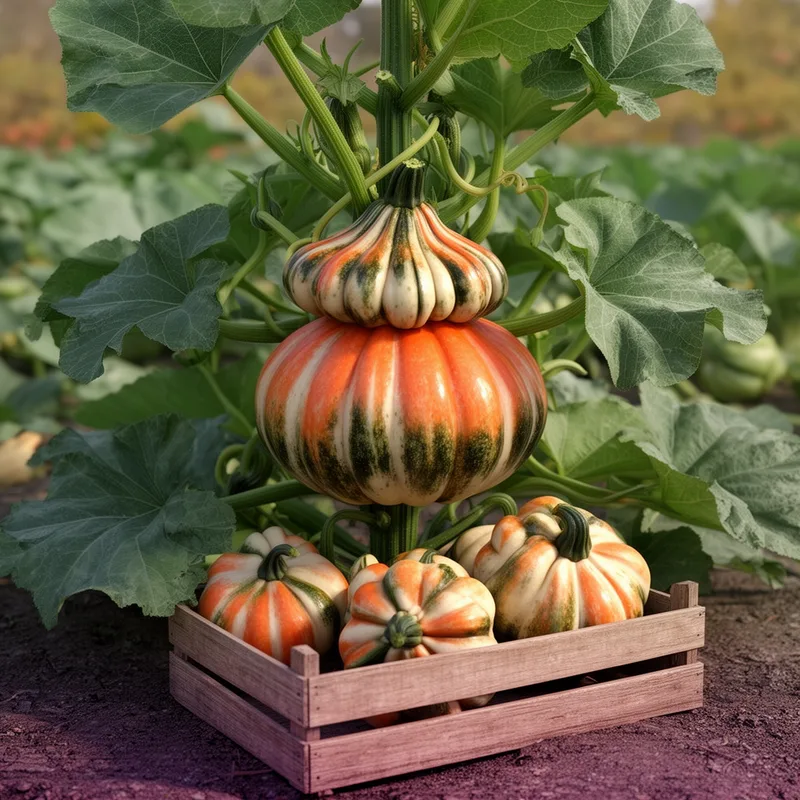
Cucurbita maxima turbaniformis
- noun
- /kuˈkɜr.bɪ.tə ˈmæk.sɪ.mə ˌtɜr.bə.nɪˈfɔr.mɪs/
- Specialized
 :
calabaza turban
:
calabaza turban
- You can easily recognize Cucurbita maxima turbaniformis by its hard shell and rounded top that resembles a turban.
Examples
-
You can easily recognize Cucurbita maxima turbaniformis by its distinctive protruding top and turban-like shape.
-
I grew a Cucurbita maxima turbaniformis in my garden this year.
-
At the autumn fair, baskets overflowed with colorful varieties of Cucurbita maxima turbaniformis.
-
Many gardeners prize Cucurbita maxima turbaniformis as a decorative as well as edible squash.
-
Have you ever tasted Cucurbita maxima turbaniformis?
-
Many gardeners prize Cucurbita maxima turbaniformis for its unique turban-like shape and vibrant colors.
-
At the harvest festival, Cucurbita maxima turbaniformis was displayed as a stunning centerpiece among other squash varieties.
Synonyms

A squash with a hard shell and a rounded top that looks like a hat used for cooking or decoration
Surface Forms
Morphology
Cucurbita + maxima + turbaniformis
The name is a taxonomic Latin compound that literally combines the genus 'Cucurbita' (a gourd/squash) with descriptive epithets: 'maxima' (largest) and 'turbaniformis' (turban-shaped). If a learner knows these constituent meanings, the overall sense — a large, turban-shaped squash — is directly compositional and therefore transparent.
Etymology
Cucurbita maxima turbaniformis comes from Latin words that describe how it looks: Cucurbita means gourd, maxima means largest, and turbaniformis means 'turban-shaped'. Imagine a round squash with a small top that sticks out like a turban; that's why the name fits this hard-shelled, decorative squash and helps you remember its shape.

