
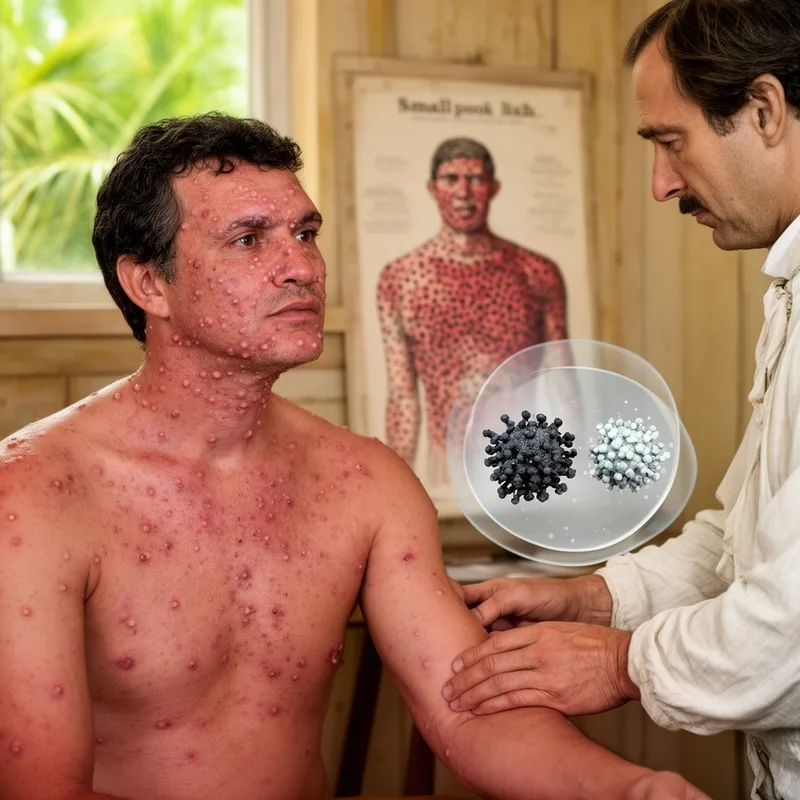
Cuban itch
- noun
- Archaic
- Doctors identified the symptoms of Cuban itch as less severe than typical smallpox.
Examples
-
The doctor diagnosed her with Cuban itch.
-
Cases of Cuban itch were reported in the region during the early 19th century.
-
Historical records mention Cuban itch among the diseases affecting Caribbean populations.
-
Many people are unaware of Cuban itch.
-
In the 19th century, outbreaks of Cuban itch affected many around the Caribbean islands.
-
Doctors clarified that Cuban itch presented milder symptoms compared to traditional smallpox.
-
Research revealed that Cuban itch was a less virulent form of the smallpox virus.
Synonyms


 1
9.9
1
9.9
A less serious form of smallpox that causes small sores and a mild fever

A mild form of smallpox caused by a weaker virus strain

A mild form of smallpox with less severe symptoms

A milder form of smallpox caused by a weaker virus

A mild form of smallpox that makes people less sick than usual

A mild type of smallpox that usually causes less severe sickness and few deaths

A mild form of a serious disease that causes fever and skin blisters, seen historically in the West Indies
How Severe

Surface Forms
Morphology
The components 'Cuban' and 'itch' transparently signal a skin-related irritation associated with Cuba, so a B1 learner would likely infer a generic itchy condition. However, the specific medical sense—a mild form of smallpox caused by a less virulent strain—is not predictable from the parts and requires specialized or cultural knowledge, making the expression only partially transparent.
Etymology
Cuban itch likely comes from reports in Cuba of a mild, itchy disease similar to smallpox. Because people talked about the itchy rash coming from Cuba, the name Cuban itch came to mean 'a mild form of smallpox'.