

Cryptotis parva
- noun
- Specialized
- The Cryptotis parva is often found in grassy areas.
Examples
-
The Cryptotis parva is one of the smallest mammals native to North America.
-
Researchers observed a population of Cryptotis parva thriving in the protected grasslands.
-
Unlike other shrews, the Cryptotis parva rarely enters wooded areas.
-
Have you ever seen a Cryptotis parva in the wild?
-
The Cryptotis parva is known for its small size and brown fur, making it well-suited for life in grassy areas.
-
Researchers have documented the habitat preferences of the Cryptotis parva, focusing on its presence in eastern United States grasslands.
-
In the summer, the Cryptotis parva can often be spotted foraging for insects in open fields.
Synonyms
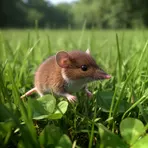
A very small brown mammal like a mouse that lives in grassy areas in the eastern United States
Surface Forms
Morphology
Cryptotis + parva
The binomial name is partially compositional: if a learner knows 'Cryptotis' as a taxonomic genus and 'parva' as Latin for 'small', they can infer it denotes a small member of that genus. However, identifying it specifically as the North American least shrew (and the detailed common-name meaning) requires taxonomic or Latin-epithet knowledge beyond ordinary vocabulary, so the relation is not fully transparent to a B1 learner.
Etymology
Cryptotis parva comes from Greek and Latin words: crypt- meaning 'hidden', otis meaning 'ear', and parva meaning 'small'. This name gives the picture of a very small shrew with tiny ears hidden in its fur, which is why it refers to the North American least shrew.

