
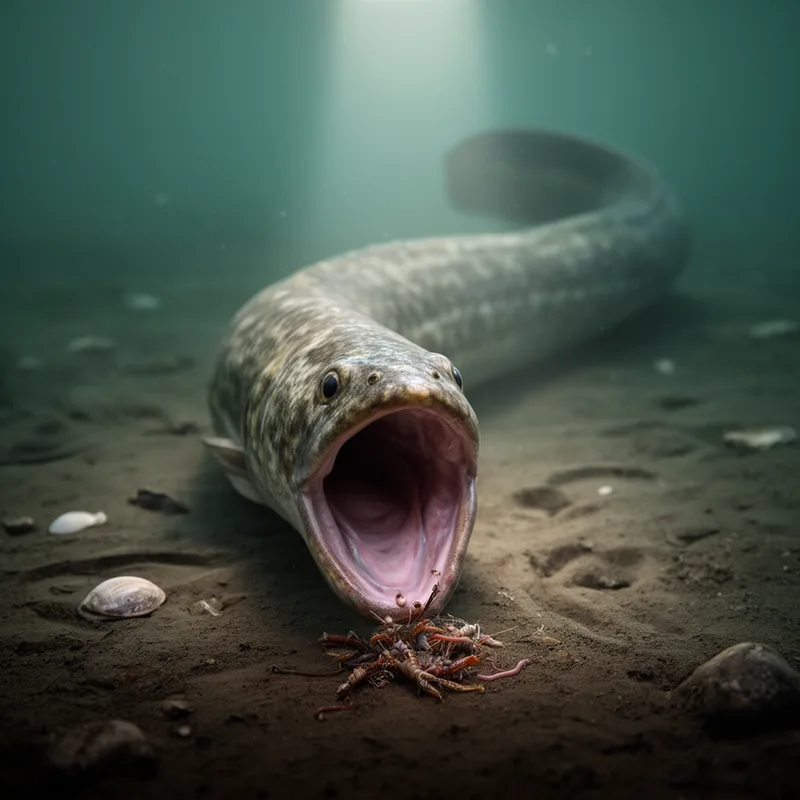
Cryptacanthodes maculatus
- noun
- Specialized
- Researchers observed a Cryptacanthodes maculatus using its large mouth to capture small invertebrates.
Examples
-
The Cryptacanthodes maculatus is rarely seen due to its preference for muddy Atlantic seabeds.
-
Fishermen occasionally catch Cryptacanthodes maculatus when trawling near the ocean floor.
-
The Cryptacanthodes maculatus is a fascinating species of fish.
-
Have you ever seen a Cryptacanthodes maculatus in the wild?
-
Fishermen occasionally catch Cryptacanthodes maculatus when trawling near the ocean floor.
-
Researchers observed a Cryptacanthodes maculatus using its large mouth to capture small invertebrates.
-
The Cryptacanthodes maculatus is rarely seen due to its preference for muddy Atlantic seabeds.
Synonyms

A fish like an eel that lives on the Atlantic Ocean floor with a large vertical mouth

An eel-like fish that lives in the North Atlantic with a long body and a large almost vertical mouth
Surface Forms
Morphology
Cryptacanthodes + maculatus
This is a Latin binomial (scientific) name functioning as a fixed taxonomic label rather than a compositional English phrase, so its meaning ('a species of eellike fish') is not predictably derivable from the surface parts. Although 'maculatus' is Latin for 'spotted', the genus name is non-transparent and most B1 learners will not know or use Latin morphology to infer the referent, making the overall expression unintelligible from its constituents.
Etymology
Cryptacanthodes maculatus may come from old Greek and Latin words: crypt meaning 'hidden', acanthodes meaning 'spiny', and maculatus meaning 'spotted', which gives the picture of a spotted, spiny fish hiding in the mud. That's why the name fits a shy, eellike bottom fish with a large, almost vertical mouth.

