
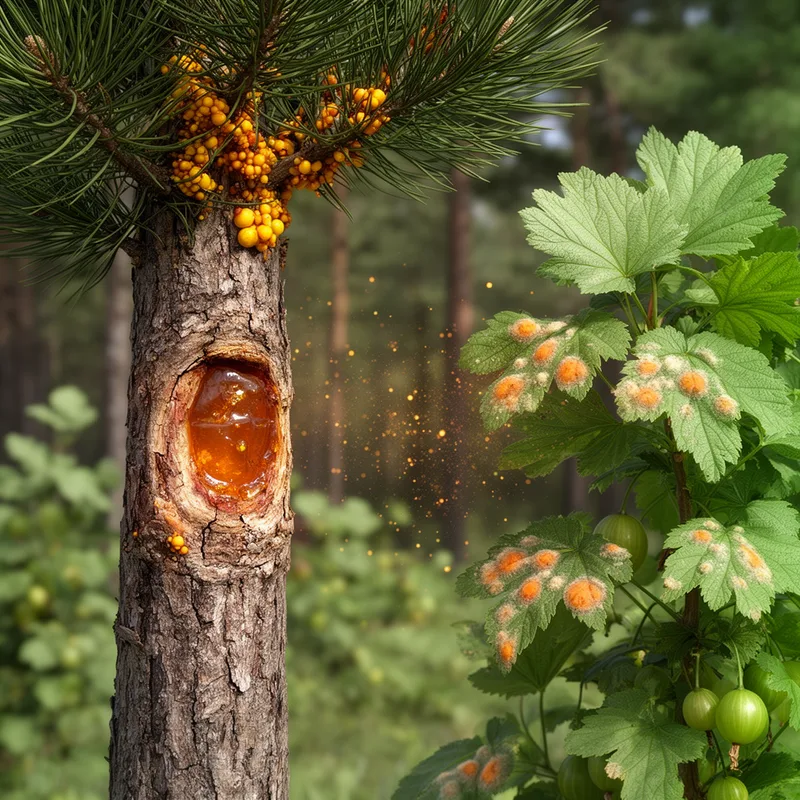
Cronartium ribicola


 1
9.9
- noun
- Specialized
- The complex life cycle of Cronartium ribicola involves both white pine and currant plants as hosts.
Examples
-
Foresters monitor areas with abundant Ribes shrubs for signs of Cronartium ribicola infection.
-
Cronartium ribicola has devastated many North American white pine forests over the last century.
-
The Cronartium ribicola fungus is known for its impact on white pines.
-
Researchers studied Cronartium ribicola to understand its life cycle.
-
Cronartium ribicola has devastated many North American white pine forests over the last century.
-
Foresters monitor areas with abundant Ribes shrubs for signs of Cronartium ribicola infection.
-
The complex life cycle of Cronartium ribicola involves both white pine and currant plants as hosts.
Surface Forms
Morphology
Cronartium + ribicola
This is a Latin binomial (scientific species name): while a learner who knows 'Cronartium' might guess it is a fungus, the species epithet 'ribicola' is a Latin-form element (not a common English word and not defined here) whose specific meaning (‘dweller on Ribes’/requires Ribes hosts) depends on botanical/Latin knowledge. The overall ecological/species information is specialized and not transparently derivable by an average B1 learner from the constituents, so it is not compositional for general learners.
Etymology
Cronartium ribicola is a scientific label that gives a clear picture. The second part, ribicola, is Latin for 'Ribes-dweller', meaning the fungus lives on Ribes shrubs, the currant plants. So the name reminds us that this fungus needs Ribes plants to grow and spread and that is why it causes white pine blister rust.