

Crocodylus porosus
- noun
- Australian
- The Crocodylus porosus is the largest living species of crocodile.
Examples
-
The habitat of Crocodylus porosus extends from eastern India to northern Australia.
-
Researchers tagged several Crocodylus porosus individuals to study their migration patterns.
-
The Crocodylus porosus is known for its impressive size.
-
In Australia, the Crocodylus porosus can be found in various habitats.
-
Researchers tagged several Crocodylus porosus individuals to study their migration patterns.
-
The Crocodylus porosus is the largest living species of crocodile.
-
The habitat of Crocodylus porosus extends from eastern India to northern Australia.
Synonyms
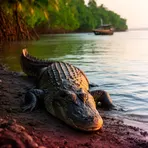
A very large crocodile that lives in rivers and near the sea in eastern Asia and nearby islands
Surface Forms
Morphology
Crocodylus + porosus
This is a taxonomic binomial: a learner who recognizes 'Crocodylus' as a genus name for crocodiles will transparently infer it refers to a crocodile species, but the species epithet 'porosus' is not an English word in the learner's lexicon and does not transparently convey the specific sense 'estuarine crocodile'. Because part of the meaning (that it is a crocodile) is clear from the constituents but the precise species-level sense is not derivable, the expression is only partially transparent to a B1 learner.
Etymology
Crocodylus porosus comes from old Greek and Latin words that give a simple picture of the animal. The first part, Crocodylus, was an old word for a crocodile and the second part, porosus, means 'full of pores' or 'pitted', so the name points to the crocodile's rough, bumpy skin and to the big saltwater or 'estuarine crocodile' we mean today.

