
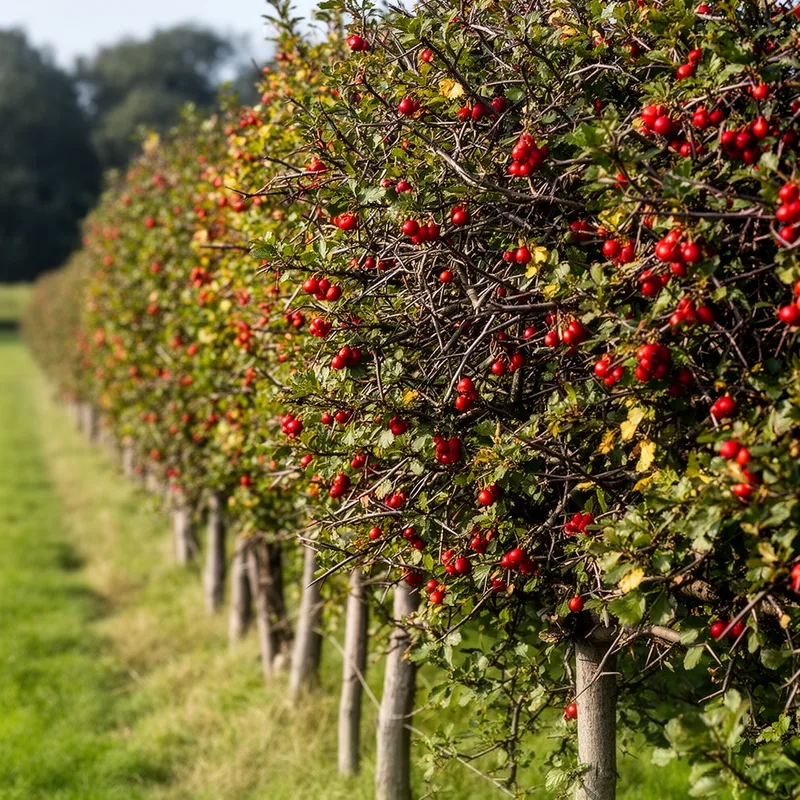
Crataegus monogyna


 1
9.9
- noun
- Specialized
- Many old English hedgerows are composed of Crataegus monogyna for its dense, thorny branches.
Examples
-
The Crataegus monogyna in the garden produces a profusion of red fruit each autumn.
-
I planted a Crataegus monogyna in my garden.
-
Biologists noted the spread of Crataegus monogyna as an introduced species in several North American states.
-
The Crataegus monogyna is often used in landscaping.
-
The Crataegus monogyna is known for its bright red fruit, which attracts many birds in the autumn.
-
In Europe, Crataegus monogyna is commonly used to create dense hedges due to its thorny branches.
-
Gardeners appreciate the Crataegus monogyna for its deeply lobed leaves and vibrant flowers in spring.
Surface Forms
Morphology
Crataegus + monogyna
This is a binomial scientific name: knowing 'Crataegus' (a genus of shrubs) lets a learner infer this is a particular species of that genus, so part of the meaning (a species of hawthorn) is compositional. However the Latin epithet 'monogyna' is not a familiar English word and does not convey the specific horticultural traits to a B1 learner, so the meaning is only partly predictable.
Etymology
Crataegus monogyna comes from ancient Greek and Latin words: Crataegus means 'strength' because the wood is very hard, and monogyna means 'one seed' as the flowers usually make fruit with a single seed. So the name points to the hawthorn's tough wood and its usually single-seeded fruit.