
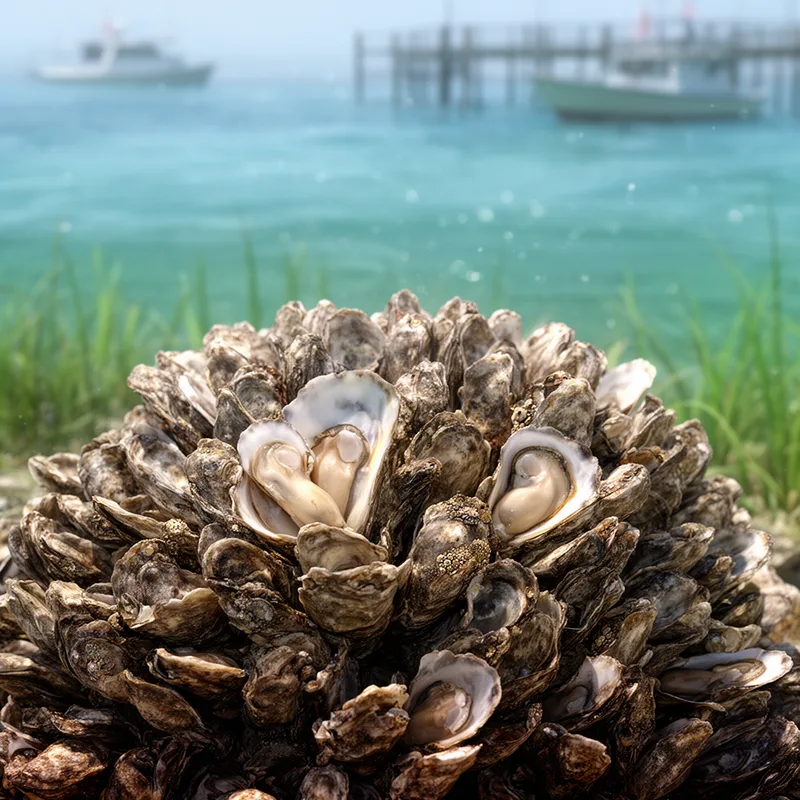
Crassostrea


 1
9.9
- noun
- /kræsˈoʊstriə/
- Specialized
- Farmers in the coastal regions cultivate Crassostrea oysters for their economic value.
- Crassostrea virginica
- Crassostrea ariakensis
- Crassostrea gigas
Examples
-
Few oysters, Crassostrea rhizophorae, occur along the north coast of Honduras.
Academic text (1996) -
The Crassostrea oyster is vital to the local ecosystem, helping filter and clean the water.
-
Recently, the aquaculture of Crassostrea gigas has also caused major changes to the remaining Dajiawa oyster reefs.
Academic text (2011) -
Extensive mortalities of oysters, Crassostrea virginica, occurred from 1985 through 1987 in coastal waters of Georgia.
Academic text (1992) -
Crassostrea ariakensis is the oyster that many politicians and watermen want to put into the bay in hopes of replacing the native oyster and quickly restoring oyster stocks.
Academic text (2005) -
PHOTO (COLOR): Figure 1. The two native U.S. oyster species are the eastern or American oyster, Crassostrea virginica (left), and the Olympia oyster, Ostreola conchaphila (right).
Academic text (1996) -
Transfer networks comparable to those known for shrimp have been created, especially for the Pacific oyster, Crassostrea gigas (Chew, 1990), and important pathogens have been transported, sometimes by complex pathways (Elston et al., 1986).
Academic text (1992) -
The Crassostrea genus includes many species of oysters that are harvested for food.
Synonyms
A group of oysters that includes the Virginia oyster
Compounds
Surface Forms
Etymology
Crassostrea comes from Latin parts crassus and ostrea, meaning 'thick' and 'oyster'. So Crassostrea literally says 'thick oyster' and is the scientific name for a group of oysters, including the Virginia oyster.