
Council of Trent
 1
9.9
1
9.9

- proper noun
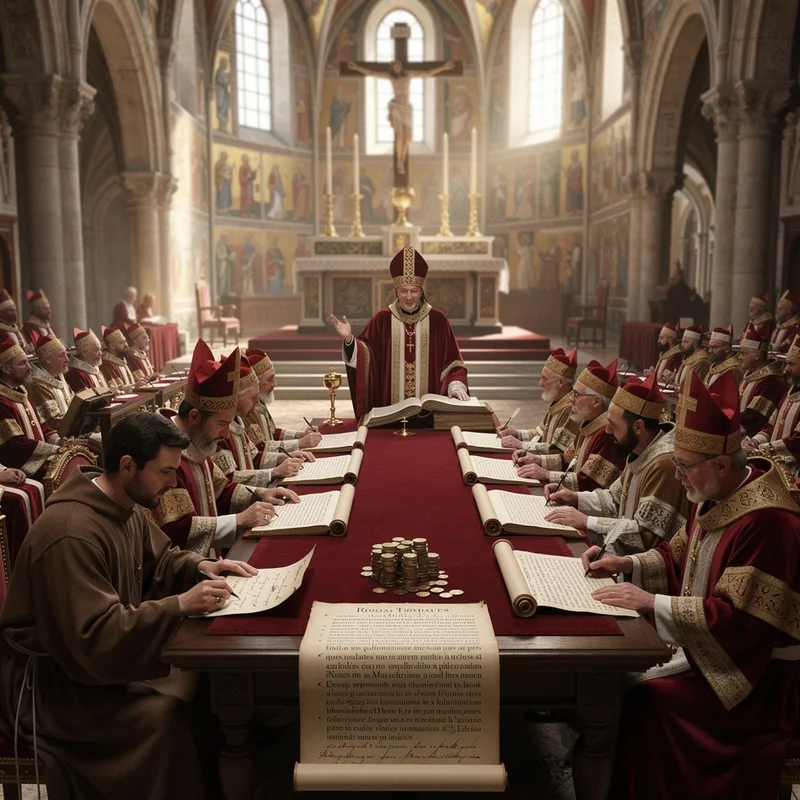
- In 1545, the Church convened the Council of Trent to address the challenges posed by the Protestant Reformation.
- decree of the Council of Trent
- Council of Trent (1563)
Examples
-
In fact, only after the Council of Trent (1545-1563) did Mary (along with some female saints) become an important figure in Christian theology.
Academic text (1999) -
According to Vittorio Peri, the Council of Trent was a wholly Western council.
Academic text (2010) -
Its approach here was not so different from that of the Council of Trent.
Academic text (2001) -
As before, the request was based on an appeal to the decrees of the Council of Trent.
Academic text (2000) -
He points out that the beginning of the reception of the Council of Trent took fifty years.
Academic text (2013) -
Of interest is that the Catechism of the Council of Trent cites Peter.
Blog text (14) -
Not until the Council of Trent does a church document identify marriage as a sacrament that confers grace.
Academic text (2009) -
But even in the Latin Church, vernacular liturgy was not unknown, both before the Council of Trent and after.
Blog text (10) -
In 1563, the Council of Trent ruled that in religious images, "figures shall not be painted or adorned with a beauty exciting to lust."
Academic text (2006) -
The ideological self-reconstruction of the Catholic Church following the Council of Trent took the form of enunciating absolute and dogmatic standards of truth.
Academic text (2002)
Surface Forms
Morphology
A B1 learner who knows 'council' (an assembly) and 'Trent' (a place) can directly infer that this refers to a council held in Trent; the 'Council of X' construction is compositionally transparent and common across languages. Although the specific historical details (dates, ecumenical status, reforms) are not derivable without background knowledge, the core meaning 'an assembly in Trent' is immediately understandable from the constituents.
Etymology
Council of Trent comes from a long meeting, a council held in the town of Trent in the 1500s where church leaders met to decide and explain what the Catholic Church taught after many people left the church. So today the phrase refers to that important set of meetings that shaped Catholic 'teaching'.