
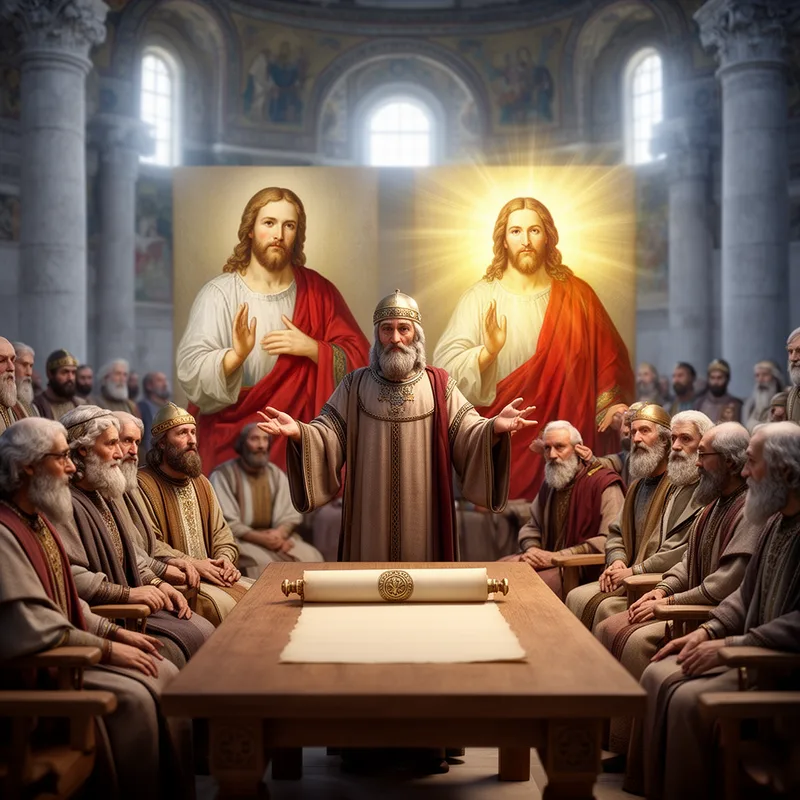
Council of Chalcedon
- proper noun
- (n53) See, for example, Gregory, Ep. 6.14, which suggests that Constantinopolitan editors had added to the acts of the Council of Chalcedon.
Examples
-
A further caution for Western readers, who are used to expressions like "the Council of Nicaea," "the Council of Chalcedon," etc., with the genitive of place, is that the Greek uses the locative, as in "the Council in Nicaea," or "the Council in Chalcedon," etc.
Academic text (2010) -
Already, the Fathers of the Council of Chalcedon had decreed in their first canon: "We decree that the canons established by the holy fathers in each and every council are to remain in force."
Academic text (2010) -
Otherwise, the genuine status of that human nature would be suspect, and Jesus would not have been "truly" human in the terms classically defined by the Council of Chalcedon.
Academic text (1992) -
Consequently, one's understanding of the Council of Chalcedon and its relationship to this Cyrillian Christology is of crucial importance for one's interpretation of Constantinople II.
Academic text (1991) -
The bishops at Constantinople repeatedly declared their loyalty to the Council of Chalcedon (canons 5, 6, 11, and 14).
Academic text (1991) -
For 240 years after the Council of Chalcedon (451), no ecumenical council had issued any norms of church discipline.
Academic text (2010) -
Leo the Great, the pope who loomed over the Council of Chalcedon, warned against edging out Christ's humanity: "It is as dangerous an evil to deny the truth of the human nature in Christ as to refuse to believe that his glory is equal to that of the Father." 23
Academic text (1992) -
After the Council, they struggled against both the strict Cyrillians and the strict Dyophysites—neither of whom could accept the compatibility of St. Cyril and the Council of Chalcedon.
Academic text (1991) -
The Council of Chalcedon, held in 451 AD, was pivotal in defining Christ's dual nature as both human and divine.
-
Many key doctrines of the Christian faith were solidified during the Council of Chalcedon.
Synonyms

A church meeting in 451 that taught Jesus is both fully human and fully God
Surface Forms
Morphology
The structure 'Council of Chalcedon' is compositionally clear: 'council' + 'of' + a place/name signals a specific assembly held at Chalcedon, so a B1 learner who knows 'council' and recognizes the proper name will infer it refers to a particular meeting. However, the detailed doctrine, date, and historical significance (the two-natures definition and its status as the fourth ecumenical council) cannot be derived from the constituents alone, so deeper meaning requires prior exposure.
Etymology
Council of Chalcedon was a big church meeting in 451 at a town called Chalcedon, where church leaders met to decide how to describe Jesus. They said Jesus has 'two natures', 'human and divine', and that decision became an important teaching for many churches, so the name now stands for that choice.

