
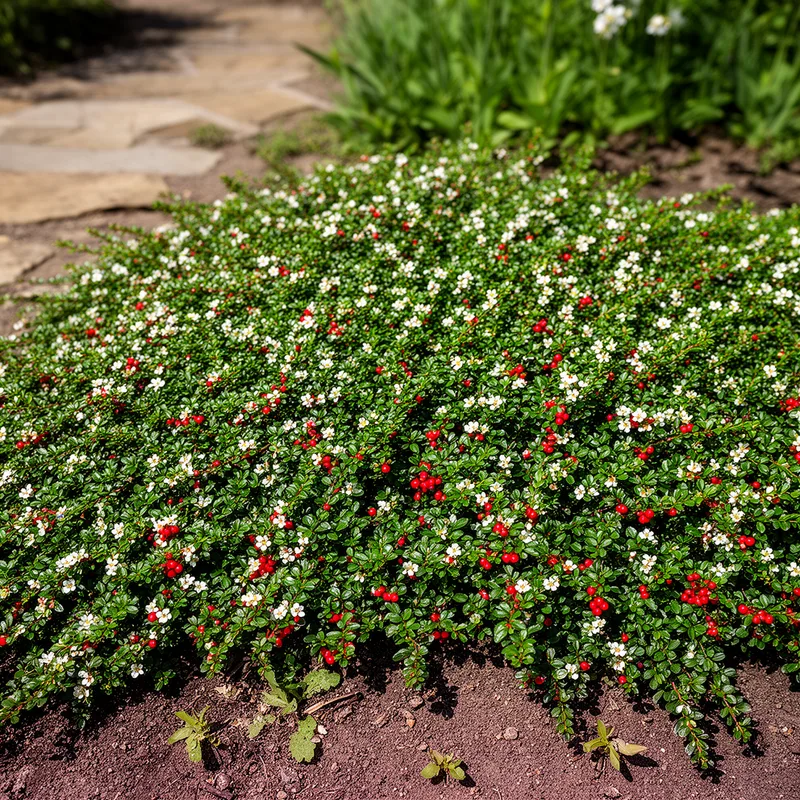
Cotoneaster dammeri


 1
9.2
- noun
- Specialized
- The bright red berries of Cotoneaster dammeri add winter color to many gardens.
Examples
-
Landscapers often plant Cotoneaster dammeri for effective and attractive ground cover.
-
Cotoneaster dammeri forms a dense mat that suppresses weed growth in the garden.
-
The Cotoneaster dammeri is perfect for ground cover.
-
We planted several Cotoneaster dammeri in our garden.
-
Cotoneaster dammeri is a popular choice among gardeners for its ability to create beautiful ground cover with its small white flowers and bright red berries.
-
Many homeowners choose to use Cotoneaster dammeri in their landscapes because it thrives in various conditions and requires minimal maintenance.
-
During the winter, the vibrant red berries of Cotoneaster dammeri provide an attractive contrast against the snow in the garden.
Synonyms
 1
9.8
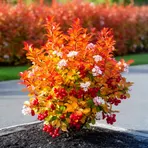
A small bush with bright autumn leaves, small white or pink flowers, and red berries
Surface Forms
Morphology
Cotoneaster + dammeri
This is a botanical binomial: knowing 'Cotoneaster' lets a learner infer the phrase denotes a kind of shrub (category is transparent), but 'dammeri' is a Latin species epithet with no compositional, common‑language meaning for a B1 learner. The specific attributes of this species (low‑growing, evergreen, berry/flower details) cannot be derived from the constituents, so overall the expression is only partially predictable.
Etymology
Cotoneaster dammeri may get its name from old words: the part cotone- comes from the word 'quince' because the plant's small red berries look like tiny quinces, and the ending -aster means 'resembling', while dammeri honors a gardener named Dammer. So the name gives an easy picture of a low, ground-cover shrub with small, quince-like fruits.