
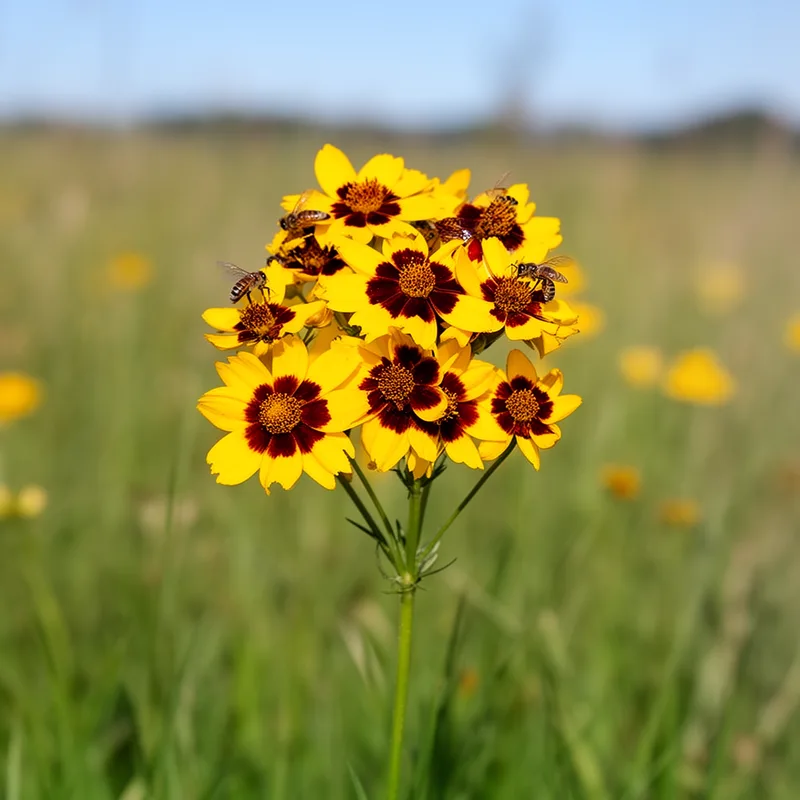
Coreopsis tinctoria
- noun
- /kɔːˈrɛɪp.sɪs tɪŋkˈtɔːr.i.ə/
- Specialized
- Many gardeners plant Coreopsis tinctoria for its vibrant yellow blooms throughout the summer.
Examples
-
In wildflower meadows, Coreopsis tinctoria attracts pollinators like bees and butterflies.
-
The dye from Coreopsis tinctoria petals has been used in traditional crafts.
-
The Coreopsis tinctoria blooms beautifully in the summer.
-
Many gardeners love Coreopsis tinctoria for its vibrant colors.
-
In wildflower meadows, Coreopsis tinctoria attracts pollinators like bees and butterflies.
-
Many gardeners plant Coreopsis tinctoria for its vibrant yellow blooms throughout the summer.
-
The Coreopsis tinctoria flowers add bright yellow color to any garden space.
Synonyms

A North American annual plant often grown in gardens for its yellow flowers with dark centers
Surface Forms
Morphology
coreopsis + tinctoria
This is a Latin binomial: knowing 'coreopsis' lets a learner infer it is a kind of coreopsis (a flowering plant), but the specific epithet 'tinctoria' is a Latin/formal species label that a B1 learner is unlikely to know or derive meaning from, and the detailed descriptive sense (bright yellow flowers with colored centers) is not predictable from the parts. Because knowing the constituents yields only a partial understanding (type of plant but not the descriptive specifics), the expression is partly but not fully transparent.
Etymology
Coreopsis tinctoria gets its name from two old words: Coreopsis comes from words meaning 'bug' and 'look' because its seeds look like tiny ticks, and tinctoria means 'used for dye' because people used the bright petals to make dye. So the name shows both how the plant looks and one of its uses.

