

Corallorhiza trifida
- noun
- Specialized
- Unlike most orchids, Corallorhiza trifida lacks true leaves and obtains nutrients from decaying matter.
Examples
-
The rare Corallorhiza trifida can often be found growing in damp woodlands at higher elevations.
-
Researchers documented several clusters of Corallorhiza trifida during their botanical survey of the Alaskan forest.
-
The rare Corallorhiza trifida blooms in shaded forests.
-
Have you seen a Corallorhiza trifida in bloom?
-
Researchers documented several clusters of Corallorhiza trifida during their botanical survey of the Alaskan forest.
-
The rare Corallorhiza trifida can often be found growing in damp woodlands at higher elevations.
-
Unlike most orchids, Corallorhiza trifida lacks true leaves and obtains nutrients from decaying matter.
Synonyms
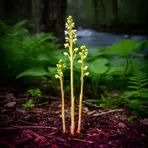
A North American orchid with pale yellow or green stems and almost no leaves
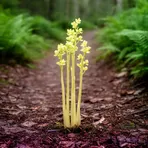
A plant with almost no leaves and pale yellow-green stems and flowers
Surface Forms
Morphology
Corallorhiza + trifida
This is a Latin binomial (scientific species) name whose meaning is taxonomic (a specific orchid) rather than a compositional English phrase; one constituent ('trifida') even has no dictionary definition provided. A B1 learner who knows the listed constituents would not be able to derive the species identity or descriptive senses without botanical or Latin knowledge, so the expression is not transparently interpretable.
Etymology
Corallorhiza trifida comes from Latin words: corallorhiza means 'coral root' because the plant's pale, branched underground roots look like pieces of coral, and trifida means 'split in three' for the flower parts that often come in threes. So the name gives a simple picture of the plant and helps you remember it.

