
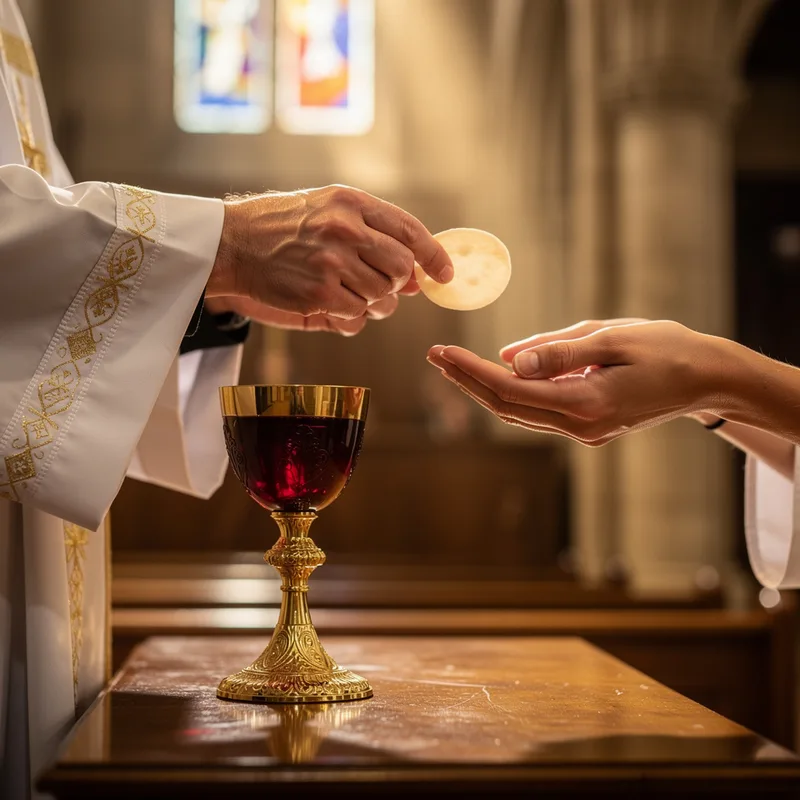
Communion
 79
7.6
79
7.6

- noun
- /kəˈmjunɪn/
- I went to First Communion.
- Holy Communion
- receive Communion
- take Communion
Loading YouTube…
Watch on YouTubeI don't vote for the same exact reasons that I don't take communion.
- I don't vote for the same exact reasons that I don't take communion.
- You did go and get your, your Holy Communion and you were confirmed.
- And then he grabs the communion.
- He performs the acts that we see as communion as part of a real meal at a real table.
- So when I and that, that, that was when that finished, went back to the headquarters, did like a report and things and spoke to some people, did Holy Communion.
Examples
-
When it came time for communion, she waited for the other women to go first.
Fiction book (1999) -
And they are encapsulated in the single sacrament of Holy Communion, the Incarnation of the Trinity.
Academic text (1990) -
You did go and get your, your Holy Communion and you were confirmed.
-
I want to give communion now.
-
We are here to celebrate with you today your first Holy Communion.
-
Father Martin has brought Holy Communion if Michael wishes to receive it today.
Fiction book (1997) -
This is Jean Marie on the day of her First Communion.
-
Respondents also reported church attendance and participation in Holy Communion every week for 10 weeks.
Academic text (1997) -
While Morn went up for Communion, I stayed in our pew, kneeling and thinking.
Fiction book (1996) -
During the service, the congregation gathered to partake in Communion, remembering the Last Supper.
Synonyms
 104
4.9
104
4.9
A Christian church service where people receive bread and wine to remember Jesus
 17
9.3
17
9.3
A Christian service when people bless and eat bread and drink wine to remember Jesus' Last Supper
 8
6.3
8
6.3
A Christian ceremony when people eat bread and drink wine to remember the Last Supper
 4
9.1
4
9.1
A Christian ceremony that blesses bread and wine to remember the Last Supper
 2
7.7
2
7.7
A Christian ceremony where people share bread and wine to remember the meal Jesus had before he died
 1
8.1
1
8.1
A Christian ceremony when people bless and eat bread and wine to remember Jesus' Last Supper
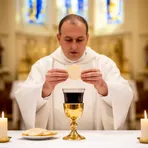

 1
9.8
1
9.8
A religious ceremony where Christians bless bread and wine to remember Jesus' Last Supper

An act in church of receiving bread and wine during a service
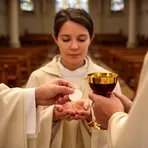
The act of receiving bread and wine during Christian Communion

A Christian service in which people receive bread and wine to show unity
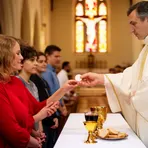
A Christian ceremony where people eat bread and drink wine to remember Jesus' death and his rising from the dead

A Christian ceremony where bread and wine are blessed and eaten to remember Jesus' Last Supper

An old Christian ceremony where people receive bread and wine
Compounds
- Formal
8
6.3
A Christian ceremony when people eat bread and drink wine to remember the Last Supper
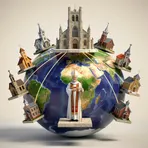 3
7.4
3
7.4
A worldwide group of national churches connected to the Church of England with the Archbishop of Canterbury as symbolic leader

Surface Forms
Morphology
Etymology
Communion comes from the old Latin word communio, which means 'sharing in common' and is the same root as common and community. In Christian use it means the sharing of bread and wine and a shared spiritual connection, so the word reminds us that the ceremony is an act of 'sharing'.