
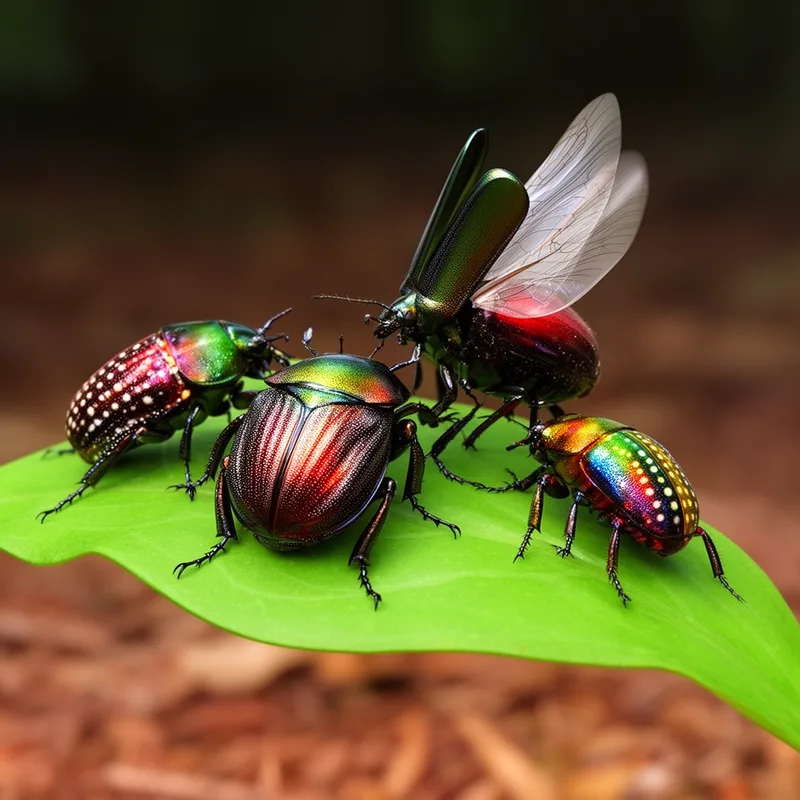
Coleoptera


 1
9.9
1
9.9
- noun
- /ˌkoʊliˈɒptərə/
- Specialized
 :
Coleoptera
:
Coleoptera
- The Coleoptera order is distinguished by beetles that play vital roles in various ecosystems.
- Coleoptera (beetle)
Examples
-
Ambrosia beetles and bark beetles (subfamily Scolytinae) represented approximately 34% and 10% of the Coleoptera, respectively.
Academic text (2010) -
Approximately 70% of the Coleoptera on the high-impact list were phloem or wood borers.
Academic text (2010) -
We included a diverse array of 119 beetle (Coleoptera) species, representing six families, on the list (Table 2).
Academic text (2010) -
More than half of the Coleoptera (53%) were assigned to the phloem- and wood-boring feeding guild.
Academic text (2010) -
Because of their generally smaller sizes, the Coleoptera (beetle) collection, numbering many thousands more species, fills 13,000 drawers and 2,000 alcohol jars.
Academic text (2002) -
Two of the four primary pollinators of Nuphar (Nymphaeaceae) species are aquatic beetles (Coleoptera) and flies (Diptera; Schneider and Moore 1977).
Academic text (1996) -
The order Coleoptera includes a vast variety of beetles that have unique adaptations for survival.
-
Many insects classified as Coleoptera exhibit hard forewings that protect their delicate flight wings.
Synonyms
 1
9.1
1
9.1
A large group of insects that are beetles with hard front wings covering their flying wings
Compounds
- Specialized
1
9.1
A large group of insects that are beetles with hard front wings covering their flying wings
Surface Forms
Etymology
Coleoptera comes from Greek parts koleos meaning 'sheath' and ptera meaning 'wings'. That's why beetles in this group have hard front wings that act like a 'sheath' covering their flying wings.