
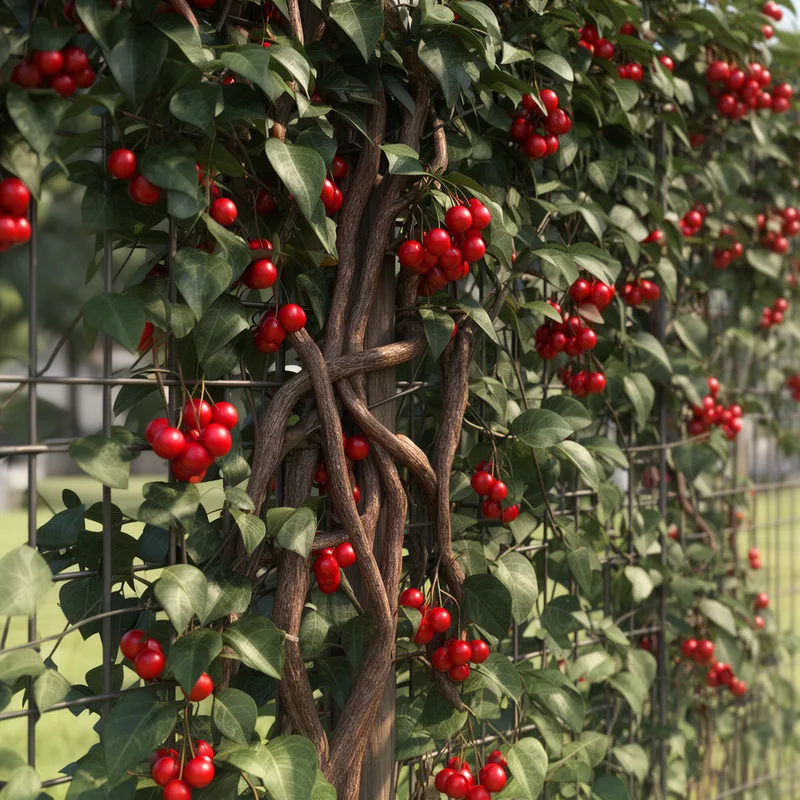
Cocculus carolinus
- noun
- Specialized
- The bright red berries of Cocculus carolinus stand out against its dark green leaves in late summer.
Examples
-
Gardeners value Cocculus carolinus for its ability to quickly cover a trellis or fence.
-
The bright red fruits of Cocculus carolinus attract birds and small wildlife throughout the summer.
-
Cocculus carolinus is sometimes called Carolina moonseed due to its resemblance to other moonseed vines.
-
The Cocculus carolinus is often found in wetland areas.
-
Have you ever seen a Cocculus carolinus in bloom?
-
Gardeners appreciate Cocculus carolinus for its lush foliage and vibrant red berries that add color to the landscape.
-
Often mistaken for the common moonseed, Cocculus carolinus distinguishes itself with its striking red berries.
Synonyms
A woody climbing plant from the southeastern United States with red fruit
Surface Forms
Morphology
Cocculus + carolinus
This is a standard Latin binomial composed of the genus name 'Cocculus' (a climber genus) plus the epithet 'carolinus' which means 'of Carolina', so the phrase transparently denotes the Cocculus species from Carolina. Although 'carolinus' is a Latin form not found in everyday dictionaries (and many B1 learners would not know it), a learner who knows both constituent meanings can directly infer the MWE's referent; scientific names are regularly formed this way across languages, supporting compositional transparency.
Etymology
Cocculus carolinus comes from old Latin and Greek words: Cocculus means 'small berry' and carolinus means 'from Carolina'. So the name simply describes a woody vine with small berries that grows in the Carolina area.

