
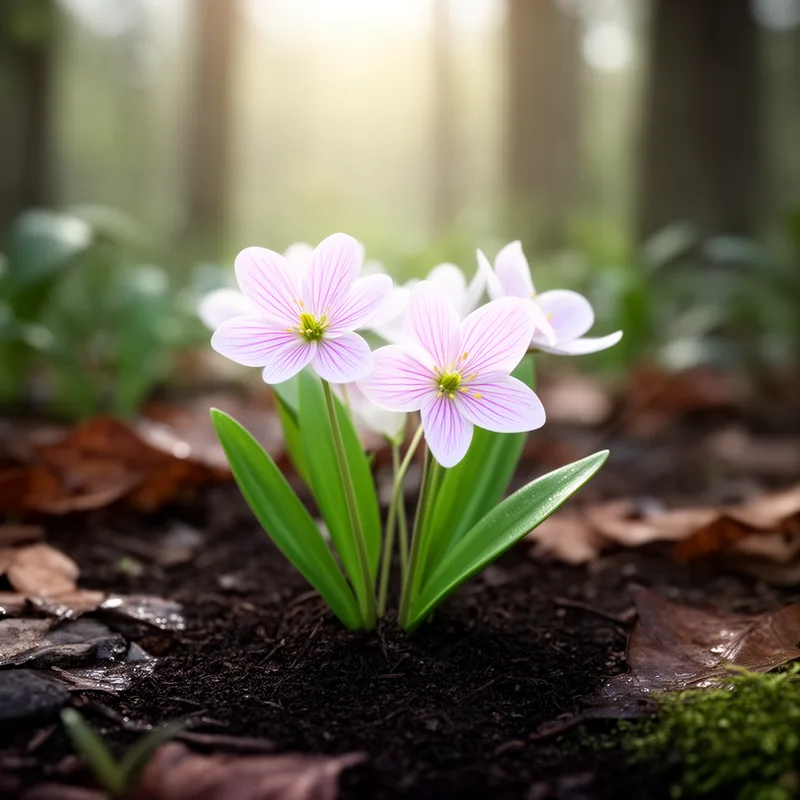
Claytonia virginica
- noun
- /kleɪˈtoʊniə vɜrˈdʒɪnɪkə/
- Specialized
- Claytonia virginica is also known as spring beauty and is one of the first wildflowers to bloom in eastern forests each spring.
Examples
-
Claytonia virginica is one of the first wildflowers to bloom in eastern forests each spring.
-
Gardeners appreciate Claytonia virginica for its delicate, star-shaped blossoms and shade tolerance.
-
The presence of Claytonia virginica can indicate rich, moist woodland soils.
-
The Claytonia virginica blooms beautifully in early spring.
-
Many gardeners love Claytonia virginica for its delicate flowers.
-
Gardeners often plant Claytonia virginica because it thrives in shady areas and produces lovely pink-tinged white flowers.
-
In spring, the bright blossoms of Claytonia virginica can be seen dotting the forest floor, attracting early pollinators.
Synonyms
A small wild plant that comes back every year with low thick leaves and small white flowers with pink edges

A small North American plant with two thick leaves, pink or white flowers, and a small edible underground bulb
Surface Forms
Morphology
Claytonia + virginica
The form is clearly compositional (genus + specific epithet), so a learner who knows 'Claytonia' would recognize this as a particular species of that genus. However 'virginica' is a Latin epithet (not a common English word) and the specific common-name meaning 'spring beauty' or geographic nuance ('of Virginia') is not directly recoverable without botanical/taxonomic knowledge, so the relation is only partially transparent to a B1 learner.
Etymology
Claytonia virginica is named after a plant collector called Clayton: Claytonia is his name and virginica means 'from Virginia'. So the full name is like saying 'Clayton's flower from Virginia', which helps you remember this small spring wildflower often called 'spring beauty'.

