
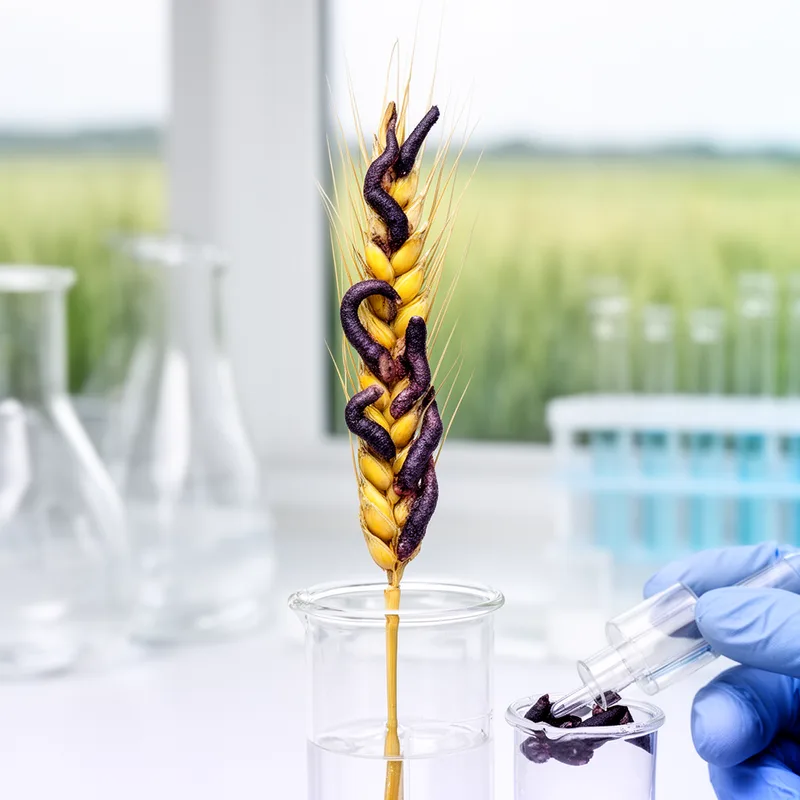
Claviceps purpurea
- noun
- /ˈklævɪˌsɛps pərˈpjʊəriə/
- NSFW
- The harvest was ruined by an outbreak of Claviceps purpurea in the rye fields.
Examples
-
Scientists extract lysergic acid from Claviceps purpurea for research purposes.
-
The presence of Claviceps purpurea in cereals can be dangerous to both humans and animals.
-
The fungus Claviceps purpurea is known for infecting rye plants.
-
Farmers should be aware of Claviceps purpurea to avoid crop loss.
-
Researchers have studied Claviceps purpurea to develop new medicinal compounds.
-
Infected rye plants often produce Claviceps purpurea, which can lead to serious health issues.
-
Farmers monitor fields closely to prevent Claviceps purpurea from contaminating their crops.
Synonyms

 3
9.9
3
9.9

A fungus that grows on grains like rye and forms black masses that can poison people
Surface Forms
Morphology
Claviceps + purpurea
This is a Latin binomial composed of a genus and specific epithet; a learner who knows 'Claviceps' as a fungus and recognizes 'purpurea' (purple) could infer it names a purple species of that fungus, so part of the meaning is recoverable. However the detailed, technical sense (infecting cereal plants, producing ergots and lysergic acid) is specialized and not derivable from the constituents alone, so the expression is not fully transparent to a B1 learner.
Etymology
Claviceps purpurea comes from Latin parts clava and ceps meaning 'club' and 'head', plus purpurea meaning 'purple'. The fungus makes dark, club-shaped bodies that replace grains in rye, so the name shows its shape and color and helps you remember it 'infects' grain.