
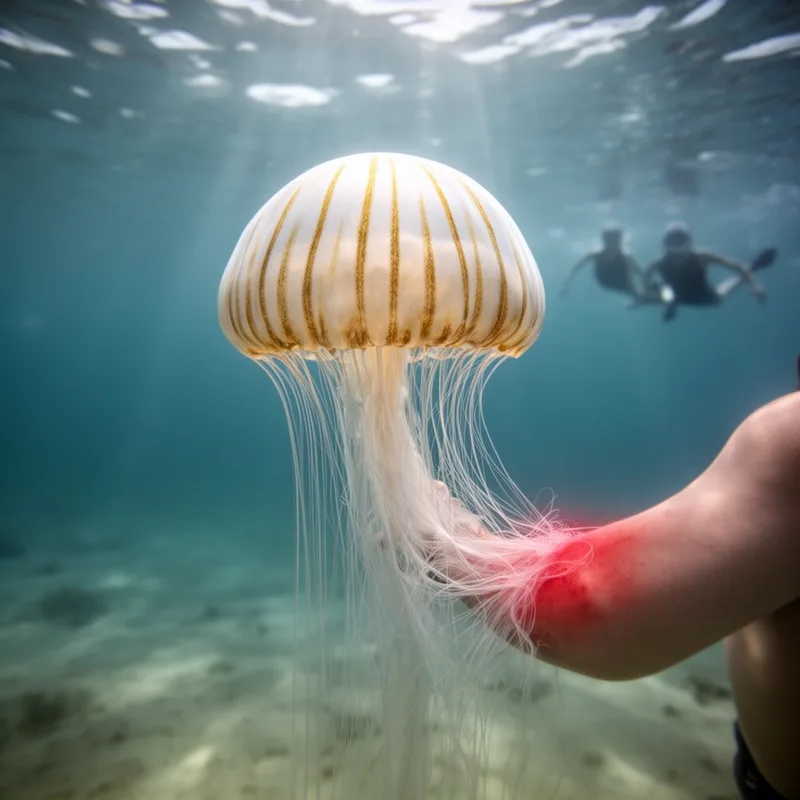
Chrysaora quinquecirrha
- noun
- Specialized
- The distinctive tentacles of Chrysaora quinquecirrha can deliver a painful sting.
Examples
-
Swimmers should be cautious in waters where Chrysaora quinquecirrha is known to inhabit.
-
Researchers collected several specimens of Chrysaora quinquecirrha for their jellyfish study.
-
The Chrysaora quinquecirrha is known for its long tentacles.
-
Many people are stung by Chrysaora quinquecirrha each summer.
-
Swimmers should be cautious in waters where Chrysaora quinquecirrha is known to inhabit.
-
Researchers collected several specimens of Chrysaora quinquecirrha for their jellyfish study.
-
The distinctive tentacles of Chrysaora quinquecirrha can deliver a painful sting.
Surface Forms
Morphology
Chrysaora + quinquecirrha
This is a Latin binomial (scientific) name and functions as a proper taxonomic label rather than an English compositional phrase; its meaning ('Atlantic sea nettle') is not derivable from ordinary English words. Even if a learner knew 'Chrysaora' as a jellyfish, the species epithet 'quinquecirrha' is a technical/Latin element (not a common English word), so the overall sense is unpredictable to a B1 learner and behaves like an opaque lexical item.
Etymology
Chrysaora quinquecirrha comes from old Greek and Latin words that describe the jellyfish: Chrysa- means 'golden', quinque- means 'five', and -cirrha suggests 'curl' or 'tentacle'. So the name creates the image of a golden jellyfish with five long curling tentacles, which helps you remember it is the Atlantic sea nettle.

