

Chlorophoneus nigrifrons
- proper noun
- Specialized
 :
Chlorophoneus nigrifrons
:
Chlorophoneus nigrifrons
- The Chlorophoneus nigrifrons can often be heard singing in the dense woodlands of East Africa.
Examples
-
Researchers observed a nesting pair of Chlorophoneus nigrifrons near the riverbank.
-
Birdwatchers were excited to spot a juvenile Chlorophoneus nigrifrons during their safari.
-
Look, a Chlorophoneus nigrifrons!
-
The Chlorophoneus nigrifrons is often spotted in the dense forests of Africa.
-
Birdwatchers were excited to spot a juvenile Chlorophoneus nigrifrons during their safari.
-
Researchers observed a nesting pair of Chlorophoneus nigrifrons near the riverbank.
-
The Chlorophoneus nigrifrons can often be heard singing in the dense woodlands of East Africa.
Synonyms
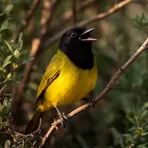
A small bright African bird with a black face and a musical song
Surface Forms
Morphology
Chlorophoneus + nigrifrons
This is a Latin binomial (genus + species) and the species epithet 'nigrifrons' is not a standard English word in learners' vocabularies; deriving the meaning requires knowledge of Latin roots (nigri- 'black' + frons 'forehead') and taxonomic conventions. Genus names are technical labels and, even if a learner knows 'Chlorophoneus' as a type of bush-shrike, the overall specific meaning is not transparently recoverable by an average B1 learner without specialist/Latin knowledge.
Etymology
Chlorophoneus nigrifrons may come from older word parts: chloro ('green'), phoneus ('voice' or 'sound') and nigrifrons ('black forehead'). This gives a clear picture of a greenish bird with a black forehead that is often heard singing, so the name describes the bird today.

