

Chionanthus virginicus
- noun
- /ˌkaɪəˈnænθəs vɜrˈdʒɪnɪkəs/
- Specialized
- Every spring, the Chionanthus virginicus in my backyard produces a cascade of fragrant white blossoms.
Examples
-
The delicate flowers of Chionanthus virginicus attract a variety of pollinators to local gardens.
-
Botanists often recommend planting Chionanthus virginicus for its ornamental beauty and ease of care.
-
The Chionanthus virginicus blooms beautifully in spring.
-
Have you seen the Chionanthus virginicus in my garden?
-
Every spring, the Chionanthus virginicus in my backyard produces a cascade of fragrant white blossoms.
-
The delicate flowers of Chionanthus virginicus attract a variety of pollinators to local gardens.
-
Botanists often recommend planting Chionanthus virginicus for its ornamental beauty and ease of care.
Synonyms

A small bushy tree from the southeastern United States that has many white flowers
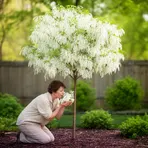
A small tree or bush grown for its fragrant white flowers
Surface Forms
Morphology
Chionanthus + virginicus
The binomial is compositionally built: 'Chionanthus' identifies the tree genus and the epithet 'virginicus' (Latin/Latinized adjective meaning 'of Virginia' or 'from Virginia') signals a particular species, so a learner who knows both constituents could infer it is a species of Chionanthus (i.e. a kind of tree associated with Virginia). However, the specific common name 'fringe tree' and detailed attributes (profuse white flowers) are not directly derivable from the parts, so the relation is only partially transparent.
Etymology
Chionanthus virginicus gets its name from Greek words chion meaning 'snow' and anthus meaning 'flower', and the Latin virginicus meaning 'of Virginia'. So the name gives a clear picture of a small tree covered in many white, snow-like flowers and points to the place where it was first noted.

