

Chemnitzer concertina
- noun
- /ˈkɛmˌnɪtsər kənˈsɜrtɪnə/
- Specialized
- He played a lively tune on his Chemnitzer concertina at the festival.
Examples
-
The Chemnitzer concertina is popular in traditional polka music.
-
She inherited her grandfather's antique Chemnitzer concertina.
-
The Chemnitzer concertina produces a unique sound.
-
Many musicians enjoy playing the Chemnitzer concertina.
-
She inherited her grandfather's antique Chemnitzer concertina.
-
Many musicians enjoy playing the Chemnitzer concertina.
-
The Chemnitzer concertina is popular in traditional polka music.
Synonyms

 3
8.8
3
8.8

A small musical instrument like an accordion that you play by pressing its ends together

A small bellows instrument with buttons on both ends, square or six-sided
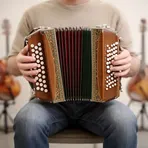
A six-sided instrument with rows of buttons that you play like a small accordion
Surface Forms
Morphology
Chemnitzer + concertina
This is a straightforward compound of an adjective denoting origin/association ('Chemnitzer' = from Chemnitz) plus the noun 'concertina' (a bellows instrument), so its meaning — a type/variety of concertina associated with Chemnitz — is directly derivable from the parts. The pattern (place-name + object type = regional variety) is cross-linguistically common and non-idiomatic, so a learner who knows both constituents will understand the MWE.
Etymology
The Chemnitzer concertina takes its name from the city of Chemnitz in Germany. This small, square concertina is a hand-held 'instrument' with bellows you push and pull and a special button layout, so its shape and the way it is played explain why people use this name today.