
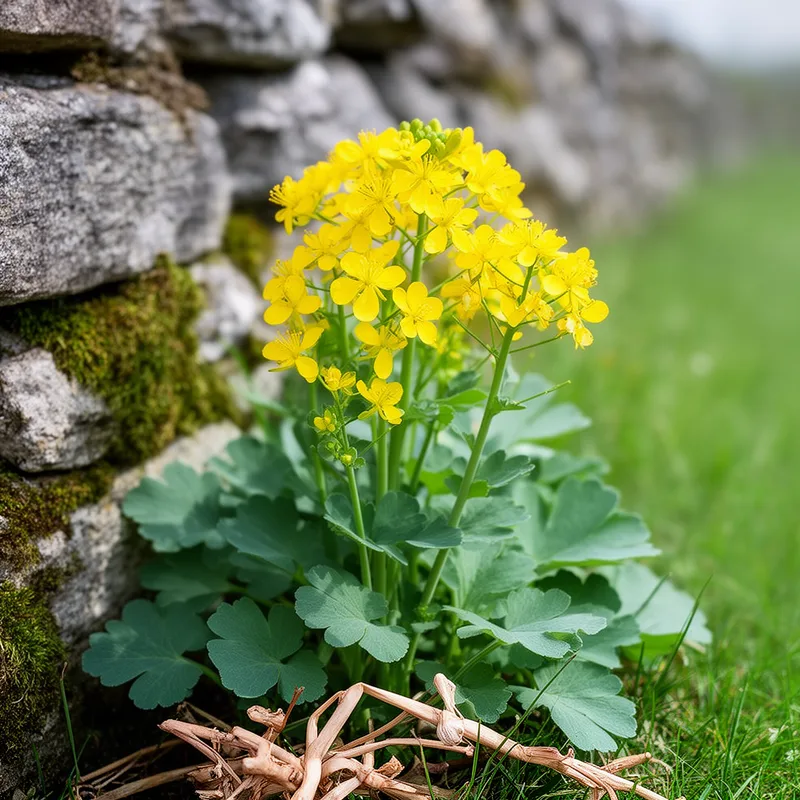
Chelidonium majus
- noun
- Specialized
- The bright yellow flowers of Chelidonium majus can be spotted along old stone walls in the countryside.
Examples
-
Gardeners sometimes cultivate Chelidonium majus for its ornamental value and historical significance.
-
Chelidonium majus has been traditionally used in herbal medicine for its supposed healing properties.
-
The Chelidonium majus is often found in gardens.
-
Have you seen the Chelidonium majus blooming this spring?
-
In the spring, the bright yellow flowers of Chelidonium majus create a stunning display across the landscape.
-
Many herbalists believe that Chelidonium majus can aid in digestion and liver health.
-
You can find Chelidonium majus growing in rocky areas and on the edges of woodlands.
Synonyms
A plant with bright yellow flowers and woody stems that grows in Europe and western Asia

A plant that lives for several years with woody stems and bright yellow flowers often in shady places

A plant that lives for many years with bright yellow flowers in dry, rocky places
Surface Forms
Morphology
Chelidonium + majus
This is a Latin botanical binomial (genus + specific epithet) whose sense ('greater celandine') is compositionally derivable if a learner recognises 'Chelidonium' as the celandine genus and knows that Latin 'majus' means 'greater'. However, 'majus' is not an English lexical item and understanding the name requires familiarity with Latin/botanical naming conventions, so the meaning is only partially predictable to a typical B1 learner.
Etymology
Chelidonium majus gets its name from old words: chelidon means 'swallow' because the yellow flowers appear when swallows return and a folk story says swallows used the plant's sap to heal their young, and majus means 'greater' in Latin. So the name helps us remember this bright yellow herb now called greater celandine.

