
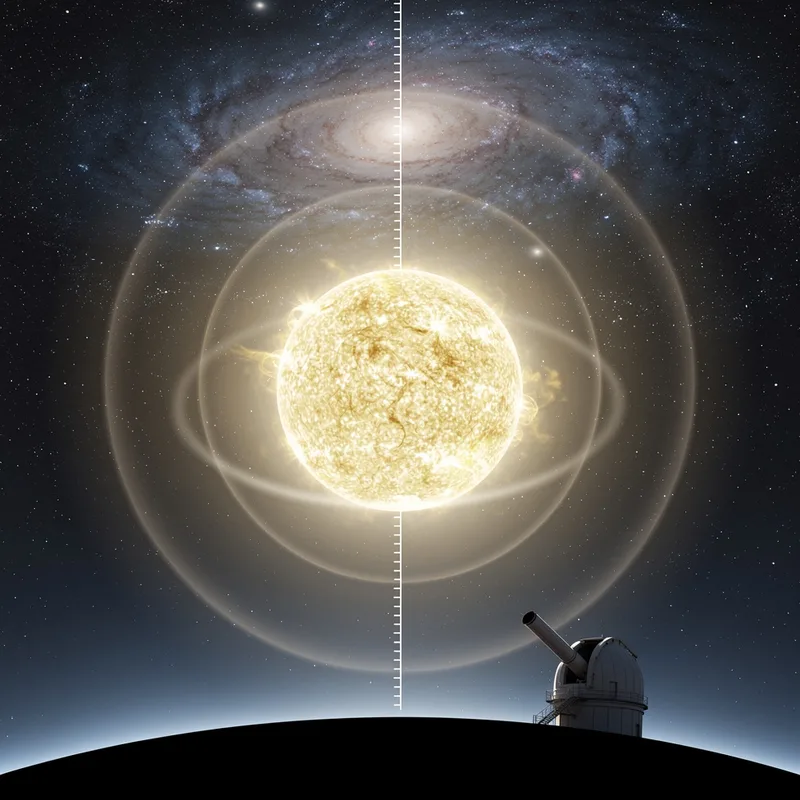
Cepheid
 1
9.9

- noun
- /ˈsɛfiˌɪd/
- Specialized
- The astronomers will also look for Cepheids in other distant galaxies.
- Cepheid variable
- Cepheid variable star
- Cepheid period
Examples
-
The most reliable indicator for distances to galaxies far from our own Milky Way involves Cepheid variable stars.
Academic text (1994) -
And Hubble recognized that as a Cepheid variable star.
-
She was able to find nine more Cepheid variables that made all the difference.
-
Forty of them turned out to be Cepheid variables, with periods ranging from 10 to 48 days.
Academic text (1993) -
The unique precision provided by Cepheid variable stars makes them the "primary" distance indicators beyond the reach of parallax.
Academic text (1994) -
Thus, one gets a distance determination simply by measuring a Cepheid's period and apparent average brightness.
Academic text (1994) -
Among the most important local distance indicators are variable stars such as Cepheids and RR Lyraes.
Academic text (1997) -
The new Cepheid results from the Hubble telescope are consistent with Tully-Fisher measurements of M100.
Academic text (1994) -
Starting with Edwin Hubble in the early 1920s, astronomers used Cepheid variable stars to measure distances to galaxies.
Academic text (2002) -
Astronomers often use Cepheid variable stars to determine the distance to faraway galaxies by analyzing their brightness patterns.
Surface Forms
Morphology
Etymology
Cepheid comes from the constellation Cepheus and the well-known star Delta Cephei, where this kind of variable star was first noticed. So a Cepheid is a star 'like' Delta Cephei that brightens and dims in a regular pattern and helps astronomers measure distances in space.