
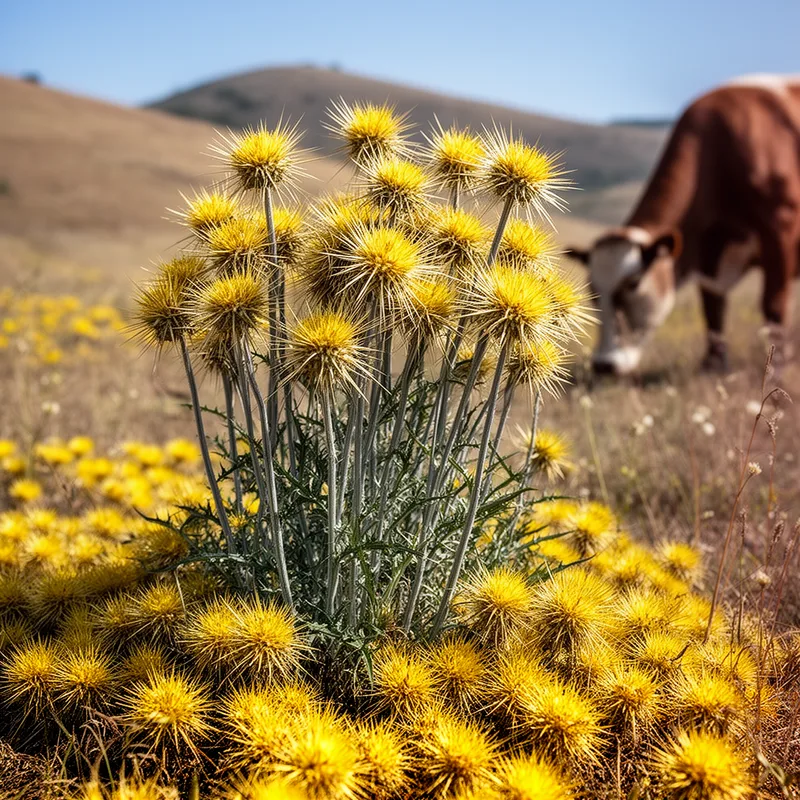
Centaurea solstitialis
- noun
- Specialized
 :
Centaurea solstitialis
:
Centaurea solstitialis
- Centaurea solstitialis has spread rapidly in California, outcompeting native plants.
Examples
-
Efforts to control Centaurea solstitialis require coordinated management of land and livestock.
-
The spiny flower heads of Centaurea solstitialis make it difficult for animals to graze.
-
The Centaurea solstitialis spreads rapidly in disturbed areas.
-
Have you seen the Centaurea solstitialis in the garden?
-
The yellow star-thistle, or Centaurea solstitialis, is often found in dry fields and roadside areas.
-
Farmers in California struggle with the spread of Centaurea solstitialis due to its invasive nature.
-
Many regions in the United States have taken measures to control Centaurea solstitialis because of its aggressive growth.
Synonyms

A European weed with spines and yellow flowers that invades fields

A weed plant with a winged stem and hairy leaves often growing near fields
Surface Forms
Morphology
Centaurea + solstitialis
The element 'Centaurea' identifies a plant genus (daisy family), so a learner who knows that word can infer this is a species of plant; however 'solstitialis' is a Latin specific epithet with no transparent English meaning and does not convey the common name or properties (yellow star‑thistle, invasive). Because part of the meaning (that it is a plant species) is derivable but the full referent and attributes are not, the expression is only partially transparent to a B1 learner.
Etymology
Centaurea solstitialis The plant's name comes from two clear images: Centaurea links to the myth of a centaur who used the plant as a medicine, and solstitialis points to the 'longest day of summer' when its bright, star-like yellow flowers appear. So, the name helps you remember this yellow 'star-thistle' weed that blooms in summer and has sharp spines.

