
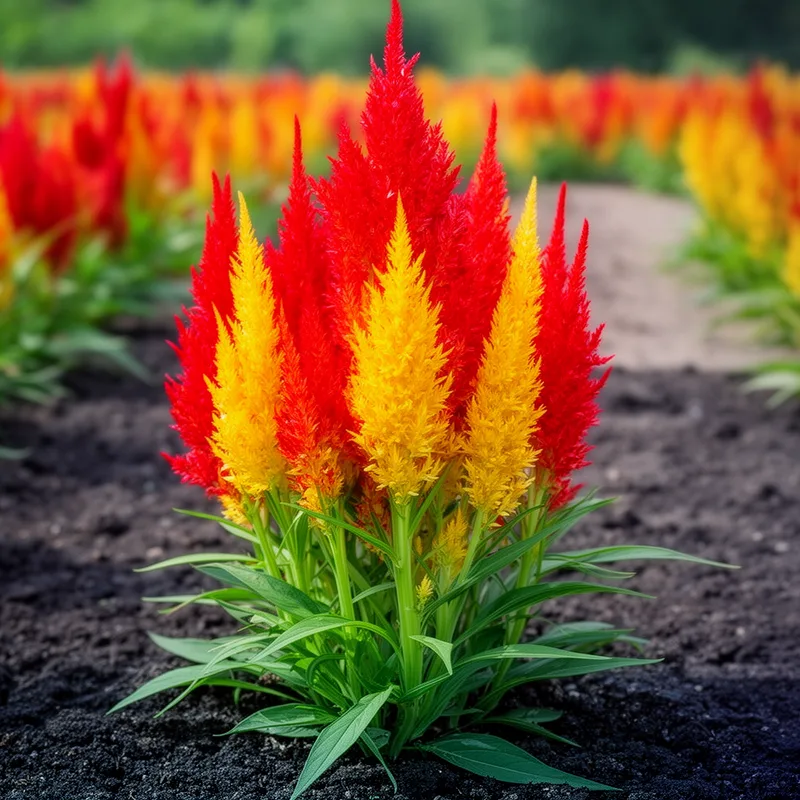
Celosia argentea cristata
- noun
- Specialized
- She planted several rows of Celosia argentea cristata along the garden path.
Examples
-
The Celosia argentea cristata added vibrant colors to the summer flowerbed.
-
Many gardeners prize Celosia argentea cristata for its unique crested blooms.
-
The Celosia argentea cristata adds vibrant color to any garden.
-
Have you seen the Celosia argentea cristata blooming this summer?
-
Many gardeners prize Celosia argentea cristata for its unique crested blooms.
-
The Celosia argentea cristata added vibrant colors to the summer flowerbed.
-
She planted several rows of Celosia argentea cristata along the garden path.
Synonyms

A garden plant with bright red or yellow feathery flower spikes

A garden flower with bright, feathery red or yellow spikes

A garden plant with bright crested flowers like a rooster's comb
Surface Forms
Morphology
Celosia + argenteum + cristata
The name is taxonomic and largely compositional (genus + species/epithets), so if a learner knew that 'Celosia' is a plant and could interpret Latin epithets (argentea ≈ silver; cristata ≈ crested) they could infer a crested/silvery Celosia. However, the use of Latin botanical epithets is specialized, one element ('cristata') is undefined here, and these Latin forms are not transparent to a typical B1 learner, so the meaning is only partly predictable.
Etymology
Celosia argentea cristata is named for the look of its flowers: the last word cristata comes from a Latin word for 'crested', because the blooms form bright, wavy crests like a 'rooster's comb'. So the name helps you remember this ornamental plant by its colorful, feathery crested flowers.

