

Cedrus deodara
- noun
- Specialized
- The Cedrus deodara is often planted in gardens for its striking appearance and ability to thrive in various climates.
- Cedrus deodara cedar
Examples
-
It is possible to combine deodar cedar (Cedrus deodara) with other plants in order to take advantage of environmental noise control properties.
Academic text (2010) -
Deodar cedar (Cedrus deodara), for example, reduces low-frequency noise more effectively than the other five plants studied, even though its dL Aep is negative.
Academic text (2010) -
Many landscapers choose Cedrus deodara for its attractive drooping branches and fragrant wood.
-
In the Himalayan region, the majestic Cedrus deodara is revered for its beauty and resilience against harsh weather.
Synonyms

 1
2.8
1
2.8

A large evergreen tree with strong, fragrant wood used for furniture

A tall cedar tree from the Himalayas with spreading drooping branches and strong wood used for building

A large cedar tree from the Himalayas with fragrant wood used for building and decoration
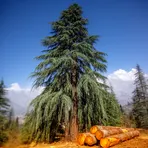
A tall evergreen tree from the Himalayas with long, hanging branches and strong wood

A tall evergreen tree from the western Himalayas with spreading, hanging branches valued for its wood and beauty
Surface Forms
Morphology
This is a botanical binomial combining the genus name 'Cedrus' and the species identifier 'deodara', so the meaning as a particular type of cedar tree is directly derivable from its constituents. Botanical naming is compositional and cross-linguistically familiar, so a learner who knows both constituent definitions would understand it denotes a cedar species.
Etymology
Cedrus deodara comes from the old Indian word deodara, from 'devadāru', meaning 'wood of the gods'. People in the Himalayas often planted these tall, beautiful trees near temples and treated them as 'sacred', so the name explains why the tree is valued for its beauty and wood today.