
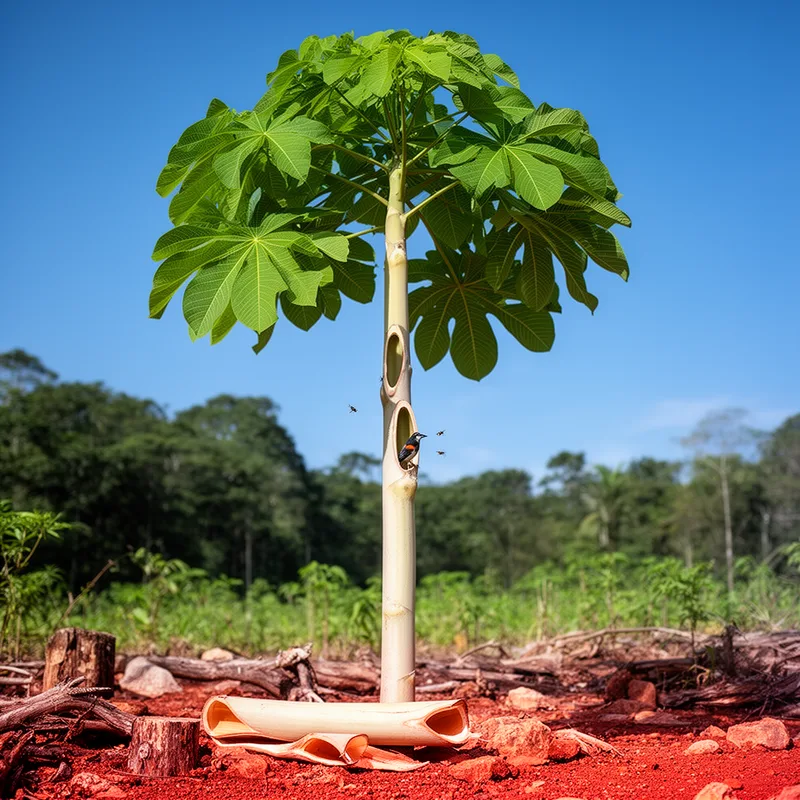
Cecropia peltata
- noun
- Specialized
- Birds and insects often shelter in the hollow stems of the Cecropia peltata tree.
Examples
-
The Cecropia peltata quickly colonizes open spaces in tropical forests.
-
Researchers studied the growth patterns of Cecropia peltata in disturbed habitats.
-
The Cecropia peltata tree is known for its large leaves.
-
Many birds nest in the Cecropia peltata trees.
-
In the rainforest, the Cecropia peltata provides shelter for various bird species due to its hollow stems.
-
The large, shield-shaped leaves of the Cecropia peltata are easily recognizable in tropical landscapes.
-
Ecologists often study the Cecropia peltata as it rapidly grows in disturbed areas, restoring the ecosystem.
Synonyms



 1
9.9
1
9.9
A tropical American tree with very hard, patterned wood used to make violin bows and fancy handles

A tropical American tree with large leaves shaped like shields and hollow stems often used for simple instruments

A tropical American tree with large broad leaves and hollow stems often planted in gardens for decoration

A tropical tree from the Americas with large leaves and hollow stems often found in rainforests

A tropical tree with large round leaves and hollow stems that often grows in rainforests
Surface Forms
Morphology
Cecropia + peltata
The binomial name combines a genus label ('Cecropia') with a species epithet that is descriptive in Latin; if a learner knew 'Cecropia' (a tree genus) and the Latin-derived 'peltata' (from peltate = shield-shaped), they could derive the meaning as a Cecropia species with shield-shaped leaves. However 'peltata' is not given in the dictionary entry and understanding this relies on botanical/Latin knowledge beyond average B1 vocabulary, so the compositional link is only partly accessible to typical learners.
Etymology
Cecropia peltata may come from an old Greek name Cecropia and from the Latin word peltata meaning 'shield-shaped'. The tree has very large, round leaves that look like shields and hollow stems that hide birds and insects, so the name helps you remember this plant.