
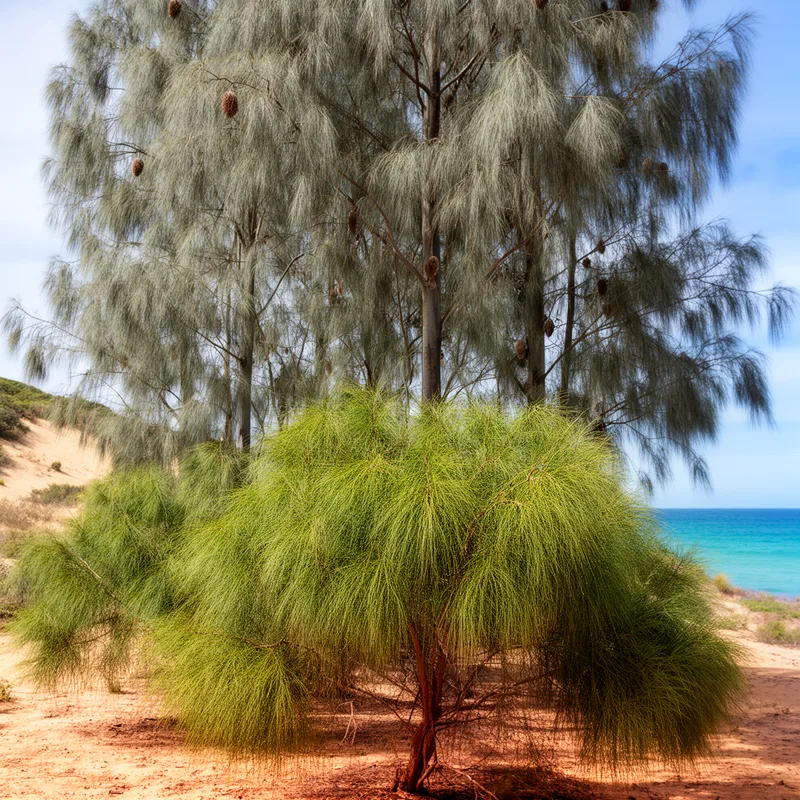
Casuarinaceae
- noun
- /ˌkæʒʊəˈrɪneɪsiː/
- Specialized
- The coastal forests were dominated by members of the Casuarinaceae, with tall she-oaks lining the dunes.
Examples
-
Several species within the Casuarinaceae family are cultivated for their use as windbreaks and timber.
-
Researchers studied the drought tolerance of plants in the Casuarinaceae to understand their adaptation in arid regions.
-
The Casuarinaceae family includes many unique species.
-
Have you ever seen a Casuarinaceae tree?
-
Researchers studied the drought tolerance of plants in the Casuarinaceae to understand their adaptation in arid regions.
-
Several species within the Casuarinaceae family are cultivated for their use as windbreaks and timber.
-
The coastal forests were dominated by members of the Casuarinaceae, with tall she-oaks lining the dunes.
Synonyms
A group of flowering trees and shrubs like she-oaks or beefwoods found in Australia
Surface Forms
Morphology
Casuarinaceae = Casuarina (semi-transparent) = casuarin + aceae
Formed by attaching the scientific family suffix '-aceae' to the genus stem 'Casuarin-', which is clear in form but uses a specialized biomedical/botanical marker learners may not know.
Etymology
Casuarinaceae comes from the plant name Casuarina, which was named after the bird 'cassowary' because the tree's thin, feather-like branches look like the bird's feathers. The ending -aceae is the usual Latin ending for a plant 'family', so Casuarinaceae simply means 'the family of Casuarina'.

