
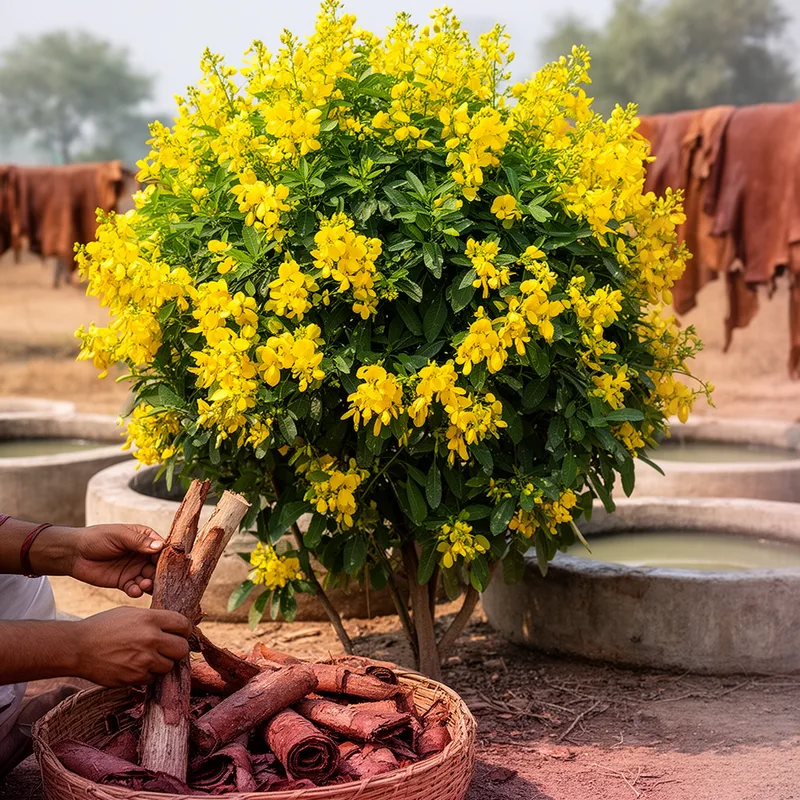
Cassia auriculata
- noun
- Specialized
- The bark of Cassia auriculata is traditionally used in the leather tanning process in India.
Examples
-
In the wild, Cassia auriculata grows abundantly and displays striking yellow flowers throughout the year.
-
Herbalists often recommend remedies made from Cassia auriculata for its medicinal properties.
-
The Cassia auriculata blooms beautifully in the spring.
-
Many gardeners love the Cassia auriculata for its vibrant color.
-
The bark of Cassia auriculata is traditionally used in the leather tanning process in India.
-
In the wild, Cassia auriculata grows abundantly and displays striking yellow flowers throughout the year.
-
Many gardeners love the Cassia auriculata for its vibrant color.
Synonyms
A small Indian bush that keeps its leaves all year and has bright yellow flowers and bark used for tanning
An Indian evergreen shrub with bright yellow flowers whose bark tans leather

An evergreen bush from India with bright yellow flowers whose bark is used to make leather
Surface Forms
Morphology
Cassia + auriculata
The form is a botanical binomial (genus + specific epithet), so a learner who knows 'Cassia' would reasonably infer this is a species of Cassia, which gives some compositional information. However, 'auriculata' is not an English lexical item here (dictionary entry missing/Latin epithet), and the detailed sense given (an evergreen Indian shrub with bright yellow flowers used for tanning) cannot be derived from the constituents without botanical/Latin knowledge, so the transparency is partial.
Etymology
Cassia auriculata gets its name from two parts: Cassia, an old name for plants with useful, scented bark, and auriculata, a Latin word meaning 'little ear' because parts of its flowers or leaves look like tiny ears. That's why the name describes this Indian shrub with bright yellow flowers and bark used in tanning and traditional medicine.

