

Casmerodius albus
- noun
- Specialized
- The Casmerodius albus can often be seen wading in shallow wetlands across Europe and Asia.
Examples
-
Unlike some other egrets, the Casmerodius albus stands out for its striking all-white plumage.
-
Researchers observed a flock of Casmerodius albus feeding along the riverbank during the migration season.
-
The Casmerodius albus is often seen wading in shallow waters.
-
Did you spot a Casmerodius albus during your trip to Africa?
-
Researchers observed a flock of Casmerodius albus feeding along the riverbank during the migration season.
-
The Casmerodius albus can often be seen wading in shallow wetlands across Europe and Asia.
-
Unlike some other egrets, the Casmerodius albus stands out for its striking all-white plumage.
Synonyms

A large white bird with long legs that lives near water in Europe, Asia, and Africa
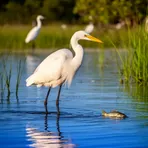
A large white heron found in the Americas that wades in shallow water to catch fish
Surface Forms
Morphology
Casmerodius + albus
This is a Latin binomial (genus + species). If a learner knew the specialized genus meaning (Casmerodius = a type of large egret) and recognised albus as ‘white’, they could reconstruct the referent, but those are technical/taxonomic items in Latin that most B1 learners will not know. Because part of the meaning is recoverable from the parts for learners with some biological/Latin knowledge but not for typical learners, the expression is only partially transparent.
Etymology
Casmerodius albus comes from two name parts: Casmerodius, an old word for a marsh heron, and albus, the Latin word for 'white'. So the name literally paints the image of a 'white marsh heron', which matches the large white egret we see today.

