
Carnot cycle
- noun
- /kɑrˈnoʊ saɪkəl/
- Specialized
- He has performed 2nd Law analysis to demonstrate why the Carnot cycle is not the valid standard for an ideal fuel-burning engine and has developed the Wicks cycle as the ideal standard and applied it to combined cycle analysis.
Examples
-
But coming back to thermodynamics, this impression that many students have about thermodynamics being all about Maxwell relations, Carnot cycles, and virial theorems is rather misleading.
Blog text (7) -
Just think of a part of a Carnot cycle experiment.
Blog text (18) -
These and other losses permit gas-compression cooling technology to reach only 50 percent of the theoretical maximum efficiency of the Carnot cycle.
Academic text (1994) -
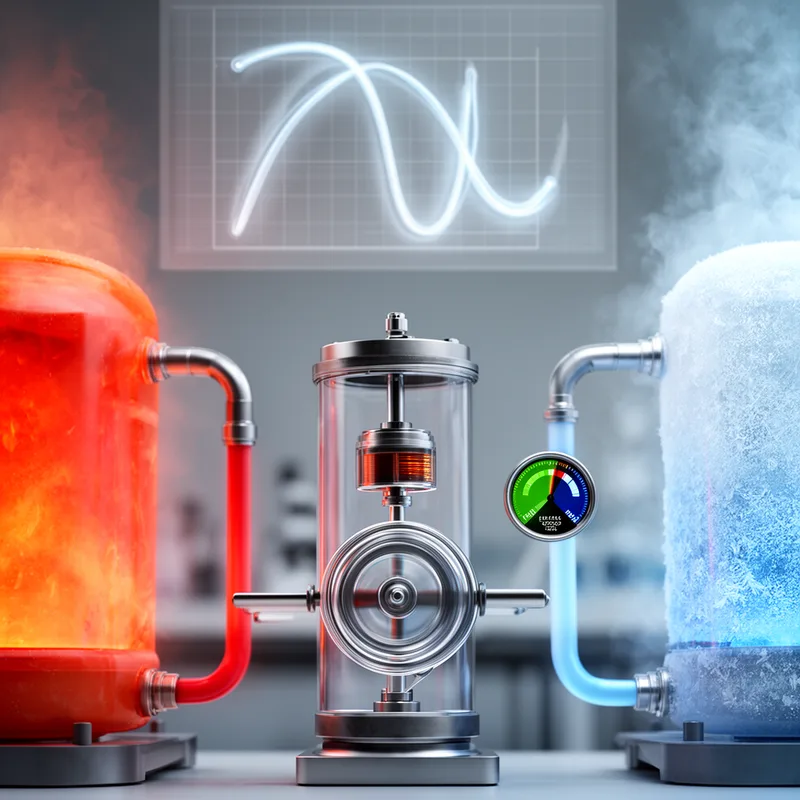
The Carnot cycle illustrates the maximum efficiency achievable by a heat engine operating between two temperatures.
-
In thermodynamics, the Carnot cycle serves as an ideal model to evaluate the performance of real heat engines.
-
Engineers study the Carnot cycle to understand how to optimize the efficiency of thermal energy conversion.
Synonyms

A model of a perfect machine that turns heat into work to show the highest possible efficiency
Surface Forms
Morphology
Carnot + cycle
The phrase pairs a proper name 'Carnot' (which carries no lexical meaning for most learners) with the known noun 'cycle' (a repeating sequence), so a B1 learner who knows 'cycle' can infer this is a particular kind of cycle named after someone but cannot derive the specialised thermodynamic sense or the idea of an ideal reversible engine. The composition therefore yields a general category (a type of cycle) but not the technical content, making the expression only partially predictable without domain knowledge.
Etymology
Carnot cycle is named after the French engineer Sadi Carnot, who imagined a very simple heat engine that runs in a perfect cycle: it expands when hot and is squeezed when cold. This clear loop image helps explain why the idea is used to show the 'best possible efficiency' a heat engine can reach.

