
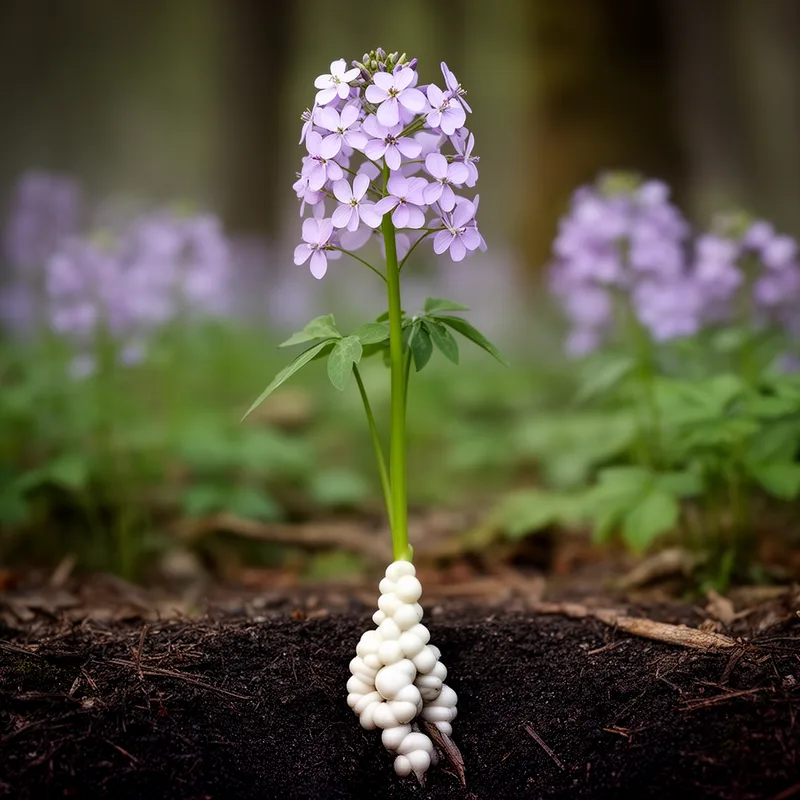
Cardamine bulbifera
- noun
- Specialized
- Gardeners appreciate Cardamine bulbifera for its decorative clusters of lilac flowers.
Examples
-
The shady woodland was full of Cardamine bulbifera, their pale flowers peeking through the undergrowth.
-
The Cardamine bulbifera blooms in early spring.
-
Botanists recorded a rare specimen of Cardamine bulbifera near the river bank.
-
Have you seen the Cardamine bulbifera in the garden?
-
Botanists appreciate Cardamine bulbifera for its unique clusters of pale lilac flowers that thrive in damp soil.
-
In the early spring, Cardamine bulbifera can be found blooming in shaded areas of the forest.
-
The garden featured a variety of plants, including Cardamine bulbifera, known for its attractive lilac blossoms.
Synonyms

A woodland plant from Europe with white flowers and a knotted bulb-shaped root

A small European plant like cress with knotted white roots that grows in damp places

A European plant with white flowers and knotted white roots that grows in moist shade

A small European wild plant with knotted white roots that grows in damp woods
Surface Forms
Morphology
Cardamine + bulbifera
This is a Latin binomial (scientific name). Knowing 'Cardamine' only gives the genus (a mustard-family plant) but the specific epithet 'bulbifera' is not a standard English word (and is not defined here), so a B1 learner who knows the listed constituents would not be able to derive the full descriptive meaning. Scientific Latin names are lexicalized and require botanical knowledge, making the expression non-compositional for general learners.
Etymology
Cardamine bulbifera comes from Latin words that describe the plant. The first part, Cardamine, is an old word for a kind of 'cress' and the second part, bulbifera, means 'bearing bulbs' because this plant makes small bulb-like growths on its stems, so the name tells us it is a cress that produces little bulbs.

