

Callitriche
- noun
- Specialized
- In freshwater ponds, Callitriche thrives, providing habitat for various aquatic creatures.
- species of Callitriche
Examples
-
Callitriche is the only genus of flowering plants that is known to have both aerial and hydrophilous pollination systems (Philbrick 1993).
Academic text (1996) -
Including Callitriche and Ceratophyllum (Figure 4), the only hydrophilous dicot genera, hydrophily has evolved as many as nine times in angiosperms.
Academic text (1996) -
However, species of Callitriche have unisexual flowers and lack perianth; thus, cleistogamy in the usual sense is not possible.
Academic text (1996) -
Hydrophily in most monocotyledons (excluding Hydrocharitaceae) and perhaps in the dicot Callitriche has conceivably evolved in such a fashion.
Academic text (1996) -
Analogous systems that involve self-pollination between unisexual flowers on a plant (geitonogamy) have been described in the dicot Callitriche (Philbrick and Anderson 1992).
Academic text (1996) -
The botanist studied Callitriche to understand its unique adaptation to waterlogged environments.
-
In many gardens, Callitriche is favored for its lush greenery and ability to attract wildlife.
Synonyms
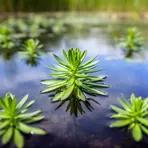
A small water plant with star-shaped groups of floating leaves
Surface Forms
Etymology
Callitriche comes from Greek parts kalli- meaning 'beautiful' and -trichē meaning 'hair', so the name literally means 'beautiful hair' and gives the image of the plant's fine, hair-like leaves or stems floating in water.

