
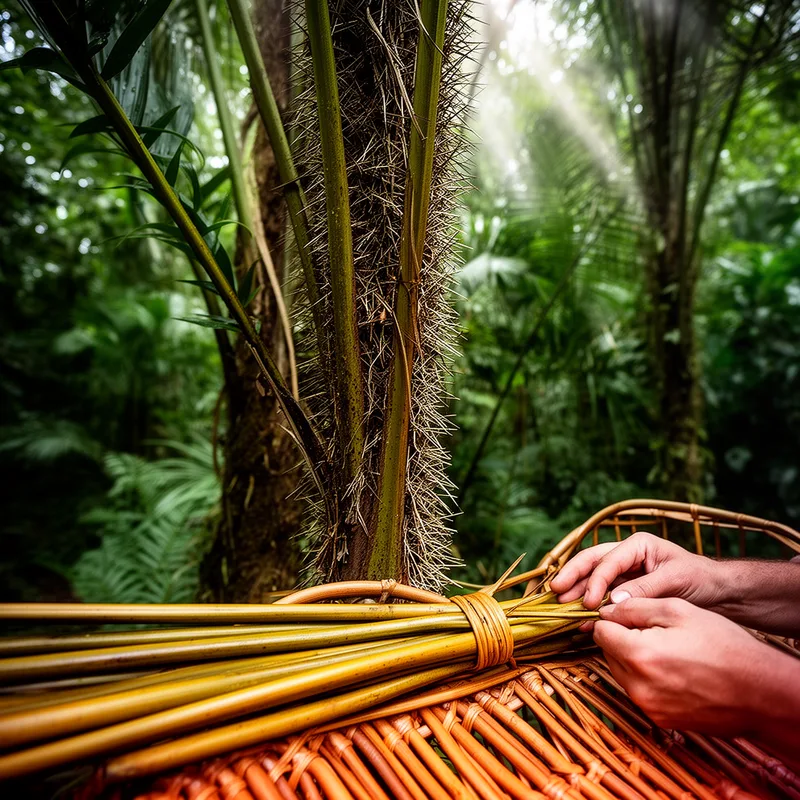
Calamus australis
- noun
- Specialized
- The tall and spiny palm, Calamus australis, thrives in the humid climate of northeastern Queensland.
Examples
-
The thick stems of Calamus australis are often used by local communities for weaving furniture.
-
The rainforest trails were covered by the long, spiny vines of Calamus australis.
-
Botanists in Australia have documented the unique growth patterns of Calamus australis.
-
The Calamus australis is often found in the rainforests of Queensland.
-
Have you ever seen a Calamus australis in its natural habitat?
-
Local artisans skillfully use the spiny stems of Calamus australis to create traditional crafts.
-
While exploring the rainforest, we encountered the climbing vines of Calamus australis reaching towards the canopy.
Synonyms
A tall palm with sharp spines that grows in northeastern Queensland
Surface Forms
Morphology
calamus + australis
This is a Linnaean binomial formed from the genus name 'calamus' (a rattan/palm) and the epithet 'australis' (Latin for 'southern' or 'of Australia'). A learner who knows both constituents can readily infer 'a southern/Australian calamus' — i.e., a species of calamus from the south/Australia — because scientific species names are compositional and used the same way across languages. The specific ecological details (spiny, scrambling) go beyond the name, but the basic referent is directly derivable from the parts.
Etymology
Calamus australis comes from old Latin words: Calamus means 'cane' and australis means 'southern'. The plant has long, cane-like, spiny stems and grows in the southern part of Australia, so the name helps you remember what it looks like and where it lives.

