
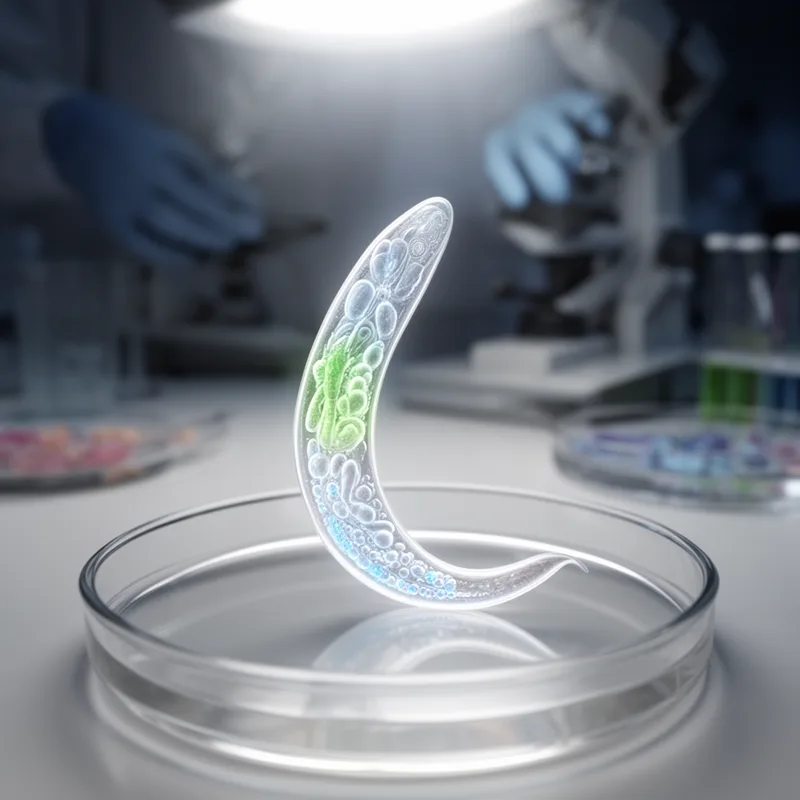
Caenorhabditis elegans


 1
8.2
- noun
- /ˌsiːnəˈræbdɪtɪs ˌɛlɪˈɡænz/
- Specialized
- The nematode Caenorhabditis elegans has become a vital model organism in genetic studies.
- Caenorhabditis elegans as a model
Examples
-
A few model organisms have greatly contributed to biological research in the last decades, among them the nematode Caenorhabditis elegans.
Academic text (2017) -
We generated a draft assembly and annotation of the genome of the free-living nematode Oscheius tipulae, a distant relative of the model Caenorhabditis elegans.
Academic text (2017) -
Researchers often use the roundworm Caenorhabditis elegans to understand fundamental biological processes.
-
Due to its simplicity, Caenorhabditis elegans is frequently chosen for research in developmental biology.
Surface Forms
Morphology
Caenorhabditis + elegans
This is a Linnaean binomial (genus + species) used as a technical species name: knowing 'Caenorhabditis' (a genus of small roundworms) gives a clear hint that the phrase refers to a worm, but the species epithet 'elegans' is a Latin label (and here not defined) and does not transparently add everyday meaning. For an average B1 learner the construction is partially informative but still technical and not fully predictable from the parts, so prior exposure or domain knowledge is usually required to grasp the full sense.
Etymology
Caenorhabditis elegans comes from word parts that paint a simple picture: Caenorhabditis combines parts meaning 'new' or 'recent' and 'rod-like', and elegans means 'elegant' or 'slender'. So the name helps you picture a small, thin, graceful worm, which fits this tiny, clear roundworm scientists use in the lab.