

CD4
 6
7.2
6
7.2

- noun
- /siː diː fɔːr/
- Specialized
- Maintaining a high number of CD4 T cells is crucial for individuals living with HIV to stay healthy.
- CD4 count
- CD4 cells
- decline in CD4
Examples
-
Similar rates of decline in CD4 count were observed with the matched San Francisco Men's Health Study cohort.
Academic text (1996) -
Since the CD4 count changes over time, we also analyzed it as a time-dependent covariate.
Academic text (2002) -
Analysis in a subset of participants with rapid CD4 count loss gave similar results.
Academic text (1996) -
The primary endpoint of the study was the rate of decline in CD4 lymphocyte count.
Academic text (1996) -
Initial findings suggested increased CD4 counts, restored T-cell immunity...
-
However, no relationship was seen between low CD4 cell counts and the development of amebic colitis.
Academic text (2012) -
For HIV-positive patients, we determined CD4 cell counts within 1 week of endoscopy.
Academic text (2012) -
Preliminary studies with another agent, atevirdine, showed improvement in CD4 counts when patients were treated with this agent and zidovudine.
Academic text (2000) -
Fluconazole-resistant oral candidosis, an emerging problem, appears most commonly in association with low CD4 counts.
Academic text (2000) -
HIV-1 may destroy CD4+ lymphocytes that are activated to combat HBV infection.
Academic text (2002)
Synonyms

A protein on helper T cells that helps the immune system and lets HIV enter cells
Compounds

- Specialized
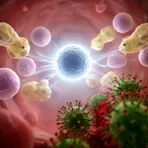
A white blood cell that helps control the immune system and that HIV attacks
- Specialized
A white blood cell that helps the body fight infection by guiding other immune cells
Surface Forms
Etymology
CD4 comes from the lab short form CD, which stands for 'cluster of differentiation', a phrase that simply means a name scientists use to 'tell cell types apart', and the '4' is the number for this one. Think of CD4 as an 'ID badge' or 'door handle' on helper T cells that HIV can grab, so doctors watch CD4 numbers to see how strong the immune system is.